
Lesson 1 : Be able to investigate and report workplace incidents and complaints in accordance with workplace requirements.
Workplace incidents and complaints provide valuable information about potential hazards, unsafe practices, and weaknesses in health and safety management systems. Effective investigation and reporting are essential for identifying the causes of incidents, addressing employee concerns, and preventing similar occurrences from happening in the future. Organisations that respond appropriately to incidents and complaints are better positioned to protect their workforce, maintain legal compliance, and promote a positive safety culture.
This lesson focuses on developing the knowledge and practical skills required to investigate and report workplace incidents and complaints in accordance with organisational procedures and workplace requirements. Learners will explore the principles of incident investigation, including evidence collection, witness interviews, record examination, and the identification of immediate and underlying causes. The lesson also examines the importance of handling workplace complaints professionally, objectively, and confidentially to ensure fair outcomes and maintain employee trust.
By the end of this lesson, learners will understand how to conduct thorough and systematic investigations, document findings accurately, and prepare clear and effective reports. They will learn how investigation outcomes can be used to recommend corrective actions, improve safety performance, and reduce the likelihood of future incidents. The skills gained through this lesson will enable learners to contribute to a safer working environment, support continuous improvement initiatives, and ensure that workplace incidents and complaints are managed consistently and in line with organisational and legal requirements.
1. Establish Prior to the Investigation All Sources of Information Available for Workplace Investigations and Select Those Appropriate and Relevant to the Incident
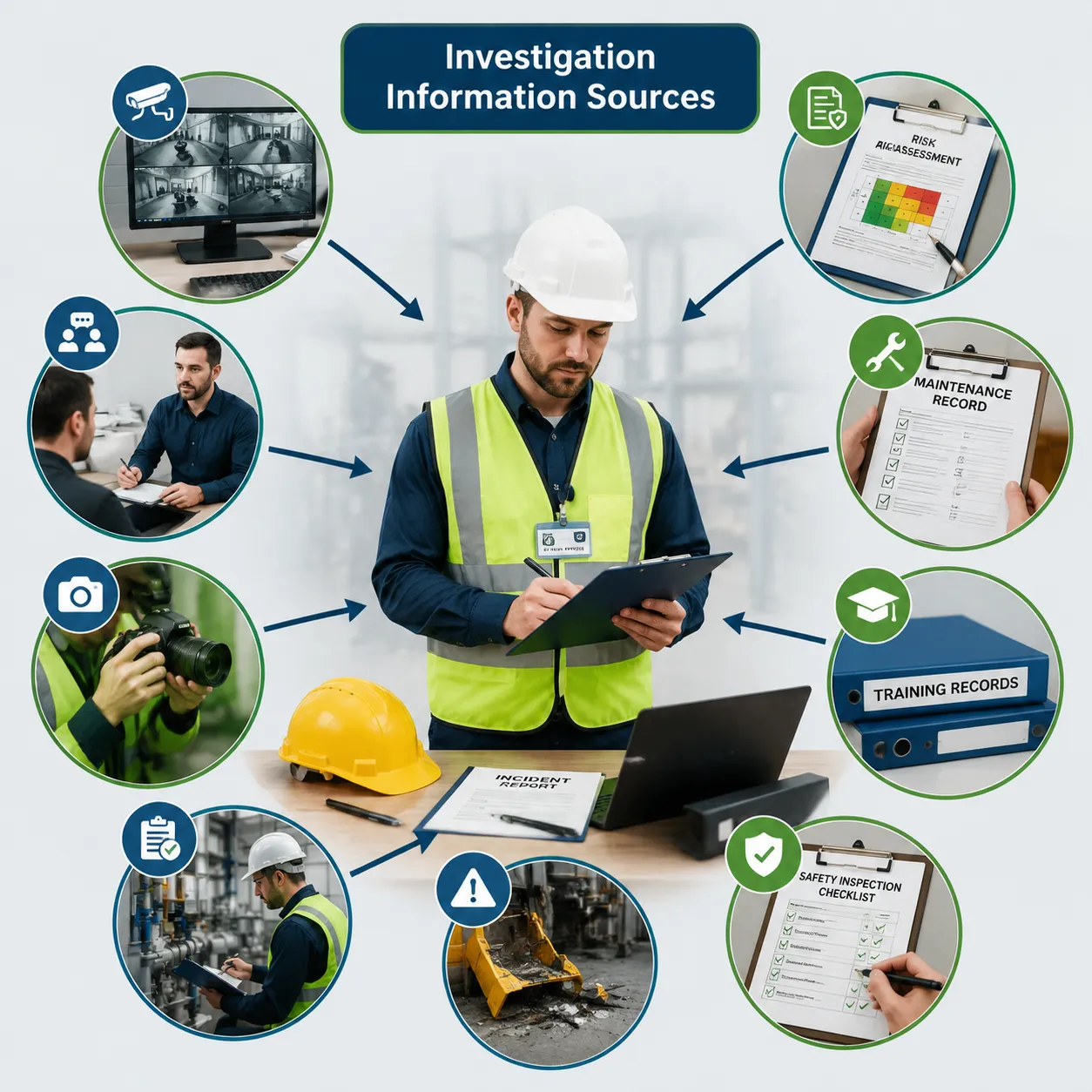
Before any workplace incident or complaint investigation begins, it is essential to identify and establish all available sources of information that may assist in determining what happened, why it happened, and how similar incidents can be prevented in the future. A thorough investigation relies on accurate, reliable, and relevant information. Without sufficient evidence and supporting information, investigators may reach incorrect conclusions, resulting in ineffective corrective actions and continued workplace risks.
The quality of an investigation is directly influenced by the quality of information collected. Therefore, investigators must carefully identify potential information sources before commencing the investigation. Not all information sources will be relevant to every incident, so it is important to evaluate and select those that are appropriate to the specific circumstances of the event being investigated.
Effective information gathering helps organisations meet legal obligations, improve workplace safety performance, strengthen employee confidence, and support continuous improvement within health and safety management systems.
Understanding Information Sources in Workplace Investigations
What Are Information Sources?
Information sources are any records, documents, observations, people, systems, or physical evidence that can provide facts, details, or insights about an incident, accident, near miss, unsafe act, unsafe condition, or workplace complaint.
These sources help investigators:
- Establish the sequence of events.
- Identify immediate causes.
- Determine underlying causes.
- Verify witness statements.
- Confirm compliance with procedures.
- Evaluate organisational controls.
- Develop appropriate corrective actions.
- Produce accurate investigation reports.
Why Information Sources Are Important
Reliable information sources enable investigators to make evidence-based decisions rather than assumptions.
Key benefits include:
- Improved investigation accuracy.
- Better identification of root causes.
- Reduced likelihood of recurring incidents.
- Enhanced legal compliance.
- Stronger workplace safety culture.
- Increased organisational learning.
- Improved risk management practices.
- Greater credibility of investigation findings.
Categories of Information Sources
Workplace investigation information generally falls into several categories.
Physical Sources
Physical evidence is often one of the most valuable sources of information because it provides direct evidence of what occurred.
Examples include:
- Damaged equipment.
- Broken machinery.
- Personal protective equipment (PPE).
- Tools involved in the incident.
- Hazardous substances.
- Warning signs.
- Safety barriers.
- Workplace layout.
- Vehicle damage.
- Environmental conditions.
Documentary Sources
Documents provide historical and operational information that may explain contributing factors.
Examples include:
- Risk assessments.
- Method statements.
- Safe systems of work.
- Training records.
- Maintenance records.
- Inspection reports.
- Permit-to-work documents.
- Health and safety policies.
- Standard operating procedures.
- Previous incident reports.
Human Sources
People often provide important firsthand information about an incident.
Examples include:
- Injured persons.
- Witnesses.
- Supervisors.
- Managers.
- Safety representatives.
- Contractors.
- Maintenance personnel.
- Visitors.
Electronic Sources
Modern workplaces generate large amounts of digital information.
Examples include:
- CCTV footage.
- Access control records.
- Vehicle tracking systems.
- Computer logs.
- Monitoring systems.
- Sensor data.
- Email communications.
- Digital maintenance records.
Information Source Selection Process
Step 1: Understand the Nature of the Incident
The first stage is understanding what type of incident has occurred.
Questions may include:
- Was there an injury?
- Was equipment involved?
- Did environmental factors contribute?
- Were procedures followed?
- Was human error involved?
- Were contractors involved?
The answers help determine which information sources are likely to be relevant.
Step 2: Identify Potential Sources
Investigators should compile a comprehensive list of available information sources before beginning detailed evidence collection.
Potential sources may include:
- Witness statements.
- Incident reports.
- CCTV recordings.
- Equipment records.
- Training documents.
- Safety inspections.
- Risk assessments.
- Maintenance records.
Step 3: Assess Relevance
Not every information source will contribute meaningful information.
Investigators should evaluate:
- Relevance to the incident.
- Reliability of the information.
- Accuracy of records.
- Timeliness of data.
- Availability of evidence.
- Legal admissibility.
Step 4: Prioritise Key Sources
Some evidence may deteriorate or disappear quickly.
Priority should be given to:
- Physical evidence.
- Witness interviews.
- CCTV footage.
- Environmental conditions.
- Equipment settings.
Table: Common Sources of Investigation Information
| Information Source | Definition | Key Purpose | Practical Example |
|---|---|---|---|
| Witness Statements | Information provided by individuals who observed the incident | Establish sequence of events | Employee reports seeing a spill before a slip accident |
| Risk Assessments | Documents identifying hazards and controls | Verify whether risks were assessed | Review assessment for forklift operations |
| CCTV Footage | Video recordings of workplace activities | Confirm actual events | Footage shows unsafe behaviour before incident |
| Training Records | Evidence of employee competence and training | Determine competency levels | Checking whether operator received required training |
| Maintenance Records | Documentation of equipment servicing and repairs | Identify equipment failures | Maintenance history reveals overdue inspection |
| Incident Reports | Formal records of accidents or complaints | Establish initial facts | Previous reports show recurring issue |
| Workplace Inspections | Safety monitoring records | Identify existing hazards | Inspection identified defective flooring |
| Safe Systems of Work | Approved procedures for tasks | Verify compliance | Worker failed to follow approved procedure |
Factors Affecting Information Reliability
Accuracy
Information must accurately represent actual events.
Reliable information should:
- Be factual.
- Be objective.
- Be verifiable.
- Be consistent.
Timeliness
Information collected immediately after an incident is generally more reliable than information collected later.
Benefits include:
- Better witness recall.
- Preservation of evidence.
- Reduced risk of information loss.
- Improved investigation quality.
Consistency
Information from multiple sources should be compared.
Investigators should:
- Compare witness accounts.
- Review documentary evidence.
- Examine physical evidence.
- Cross-reference findings.
Practical Example
Incident Scenario
A warehouse employee slips and falls while transporting materials.
Before beginning the investigation, the investigator identifies the following information sources:
- CCTV footage.
- Witness statements.
- Risk assessment records.
- Floor inspection records.
- Cleaning schedules.
- Training records.
- Photographs of the scene.
After reviewing the incident, the investigator determines that CCTV footage, witness statements, floor inspection reports, and cleaning records are the most relevant sources.
The investigation reveals that a liquid spill had not been cleaned promptly, resulting in the accident. Corrective actions include improving housekeeping procedures and implementing more frequent inspections.
Common Challenges When Selecting Information Sources
Information Overload
Investigators may have access to excessive amounts of information.
Challenges include:
- Time delays.
- Irrelevant evidence.
- Increased complexity.
- Missed critical details.
Missing Information
Some information may be unavailable.
Examples include:
- Damaged records.
- Missing CCTV footage.
- Unavailable witnesses.
- Incomplete reports.
Conflicting Information
Different sources may provide contradictory evidence.
Investigators should:
- Verify facts.
- Seek additional evidence.
- Compare multiple sources.
- Maintain objectivity.
Case Study: Machinery-Related Workplace Incident
Background
A manufacturing employee suffered a hand injury while operating a packaging machine. The organisation initiated an investigation to determine the causes and identify corrective actions.
Information Sources Identified
The investigation team established the following available sources:
- CCTV footage.
- Machine maintenance records.
- Operator training records.
- Witness statements.
- Risk assessment documentation.
- Safe operating procedures.
- Previous incident reports.
- Physical inspection of machinery.
Findings
The investigation revealed that the machine safety guard had been removed during maintenance and had not been properly reinstalled. Maintenance records showed incomplete documentation, while CCTV footage confirmed operation of the machine without adequate guarding.
Training records indicated that the operator had received appropriate instruction; therefore, inadequate training was not considered a contributing factor.
Corrective Actions
The organisation implemented several improvements:
- Enhanced maintenance verification procedures.
- Improved inspection checklists.
- Additional supervisor monitoring.
- Updated maintenance training.
- Regular audits of machine guarding systems.
This case demonstrates the importance of identifying and selecting appropriate information sources before beginning an investigation. By using multiple sources of evidence, investigators were able to identify the true root cause of the incident and implement effective corrective measures. A structured approach to information source selection improves investigation quality, supports legal compliance, and contributes to a safer workplace environment.
2. Carry Out an Investigation by Gathering Accurate and Comprehensive Recorded Information from Those Involved, Ensuring an Understanding About the Process Which Allows for Supportive Working Relationships
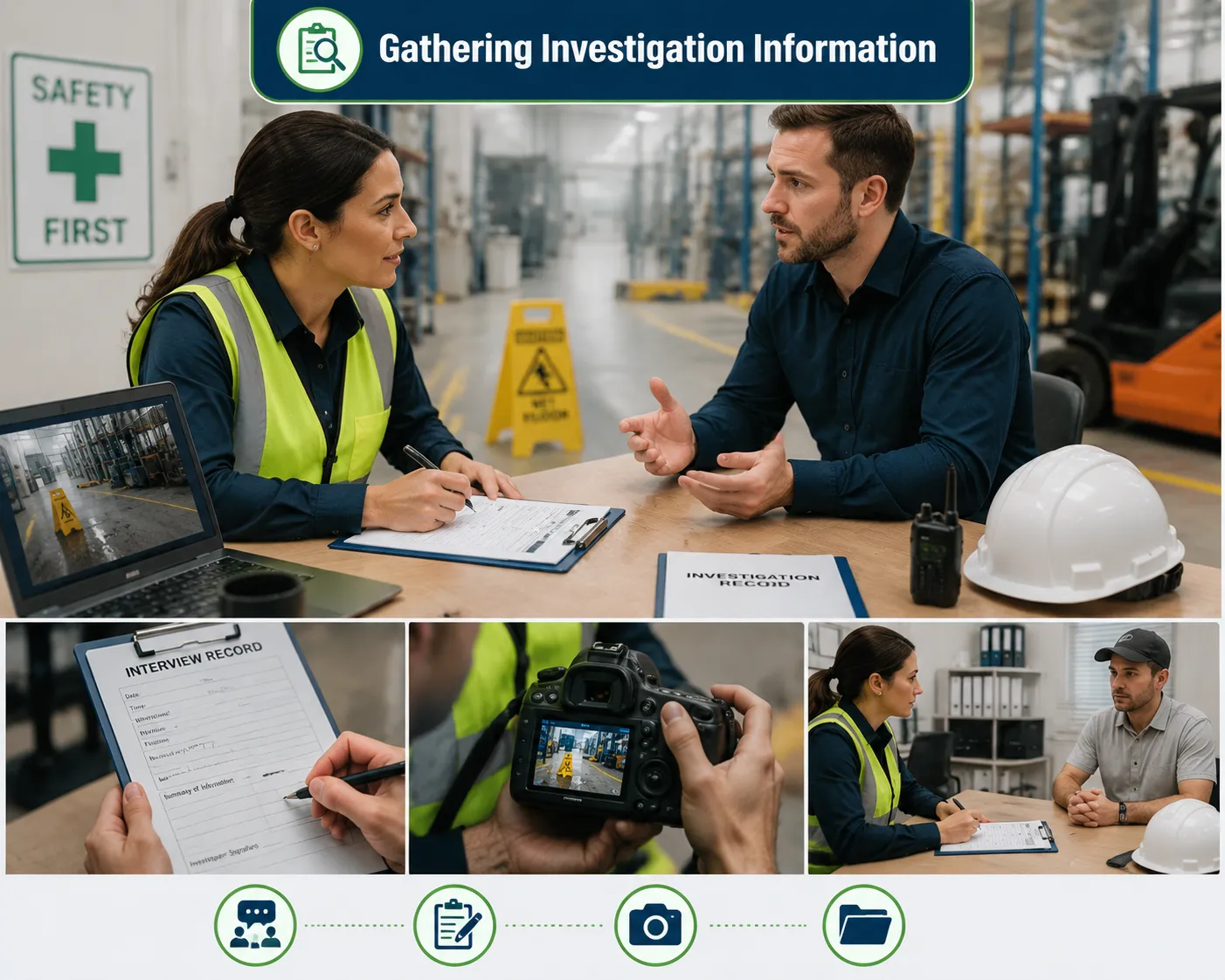
A workplace investigation is only as effective as the information gathered during the investigation process. Whether investigating an accident, near miss, dangerous occurrence, occupational illness, unsafe act, unsafe condition, or employee complaint, investigators must obtain accurate, reliable, and comprehensive information from all relevant parties. The quality of collected information directly influences the accuracy of findings, the identification of root causes, and the effectiveness of corrective actions implemented following the investigation.
Information gathering is not simply a matter of asking questions and recording answers. It requires careful planning, effective communication, active listening, professional interviewing techniques, and the ability to create a supportive environment where individuals feel comfortable providing truthful and complete information. Employees may be anxious, fearful, embarrassed, or concerned about blame and disciplinary consequences. Therefore, investigators must ensure that participants understand the purpose of the investigation and feel supported throughout the process.
An effective investigation seeks facts rather than fault. By gathering accurate and comprehensive recorded information while maintaining positive working relationships, organisations can identify lessons learned, improve workplace safety, prevent future incidents, and strengthen trust between management and employees.
Understanding Workplace Investigation Information Gathering
What Is Information Gathering?
Information gathering is the systematic process of collecting, recording, verifying, and analysing facts, evidence, observations, and statements relating to a workplace incident or complaint.
The purpose is to:
- Establish what happened.
- Determine when the incident occurred.
- Identify where the incident took place.
- Understand how the incident occurred.
- Identify immediate causes.
- Determine underlying causes.
- Assess contributing factors.
- Recommend corrective actions.
- Prevent recurrence.
Importance of Accurate Information
Accurate information forms the foundation of every successful investigation.
Benefits include:
- Reliable investigation findings.
- Fair and objective decision-making.
- Improved workplace safety.
- Legal compliance.
- Stronger organisational credibility.
- Better risk management.
- Effective corrective actions.
- Increased employee confidence.
Without accurate information, investigators may:
- Reach incorrect conclusions.
- Misidentify causes.
- Implement ineffective controls.
- Damage employee trust.
- Create legal liabilities.
Principles of Effective Information Gathering
Objectivity
Investigators must remain impartial throughout the investigation.
They should:
- Avoid assumptions.
- Focus on facts.
- Consider all evidence equally.
- Remain unbiased.
- Follow organisational procedures.
Accuracy
All information should be recorded exactly as provided.
Good practice includes:
- Recording statements verbatim where possible.
- Verifying information.
- Using factual language.
- Avoiding personal opinions.
- Confirming understanding with interviewees.
Confidentiality
Investigation information often contains sensitive details.
Confidentiality helps:
- Protect privacy.
- Encourage honesty.
- Maintain trust.
- Reduce workplace tension.
- Support professional relationships.
Respect
All individuals involved should be treated fairly and professionally.
Investigators should:
- Show empathy.
- Listen actively.
- Avoid blame.
- Maintain professionalism.
- Respect individual perspectives.
Preparing for Information Gathering
Establish Investigation Objectives
Before collecting information, investigators should clearly define what information is required.
Key questions include:
- What happened?
- Who was involved?
- What evidence exists?
- What procedures applied?
- What controls were in place?
- Were legal requirements met?
Identify Relevant Individuals
Information may need to be obtained from several sources.
Potential participants include:
- Injured employees.
- Witnesses.
- Supervisors.
- Managers.
- Contractors.
- Safety representatives.
- Maintenance personnel.
- Visitors.
- Security personnel.
Select Appropriate Information Collection Methods
Different situations require different methods.
Common methods include:
- Interviews.
- Questionnaires.
- Written statements.
- Site inspections.
- Document reviews.
- Photographic evidence.
- Video recordings.
- Electronic records analysis.
Building Supportive Working Relationships During Investigations
Why Supportive Relationships Matter
Employees are more likely to provide accurate information when they feel respected and supported.
Positive relationships encourage:
- Honest communication.
- Greater cooperation.
- Increased trust.
- Better quality evidence.
- Reduced workplace conflict.
Creating a Positive Investigation Environment
Investigators should create an environment where individuals feel comfortable participating.
Key approaches include:
- Explaining the purpose of the investigation.
- Reassuring participants about confidentiality.
- Demonstrating professionalism.
- Encouraging open discussion.
- Allowing individuals time to explain events.
- Avoiding intimidation.
Communication Techniques
Effective communication is essential.
Good communication practices include:
- Using clear language.
- Asking open-ended questions.
- Maintaining eye contact.
- Demonstrating active listening.
- Avoiding interruptions.
- Clarifying unclear responses.
Interviewing Individuals Involved in the Incident
Purpose of Interviews
Interviews provide firsthand information regarding the incident.
Objectives include:
- Understanding events.
- Clarifying circumstances.
- Identifying hazards.
- Establishing timelines.
- Confirming evidence.
Types of Interviewees
Injured Persons
The injured person may provide valuable information regarding:
- Tasks being performed.
- Equipment used.
- Environmental conditions.
- Actions immediately before the incident.
Witnesses
Witnesses can provide:
- Independent observations.
- Event timelines.
- Behavioural information.
- Environmental details.
Supervisors
Supervisors may provide information regarding:
- Training.
- Supervision levels.
- Procedures.
- Previous concerns.
Managers
Managers may contribute information regarding:
- Organisational controls.
- Resources.
- Risk assessments.
- Safety systems.
Conducting Effective Interviews
Planning the Interview
Preparation improves interview effectiveness.
Investigators should:
- Review available evidence.
- Prepare relevant questions.
- Arrange a suitable location.
- Schedule adequate time.
- Ensure privacy.
Open-Ended Questions
Open-ended questions encourage detailed responses.
Examples include:
- “Can you describe what happened?”
- “What were you doing before the incident?”
- “What did you observe?”
- “How did the situation develop?”
Closed Questions
Closed questions help verify specific facts.
Examples include:
- “Were you wearing PPE?”
- “Was the machine operating?”
- “Did you receive training?”
Active Listening
Investigators should:
- Listen carefully.
- Avoid interrupting.
- Take notes.
- Seek clarification.
- Confirm understanding.
Recording Investigation Information
Importance of Accurate Records
Accurate records preserve evidence and support investigation findings.
Benefits include:
- Improved reliability.
- Legal protection.
- Consistent reporting.
- Better analysis.
- Organisational learning.
Information That Should Be Recorded
Investigators should document:
- Dates and times.
- Locations.
- Witness details.
- Interview summaries.
- Photographic evidence.
- Physical observations.
- Equipment details.
- Environmental conditions.
Recording Methods
Common methods include:
- Written notes.
- Investigation forms.
- Electronic systems.
- Audio recordings (where permitted).
- Photographs.
- Video evidence.
Table: Key Sources of Recorded Information During Investigations
| Information Source | Definition | Purpose | Example |
|---|---|---|---|
| Witness Statement | Account provided by an individual who observed the event | Establish sequence of events | Employee describes seeing a spill before a fall |
| Interview Notes | Investigator’s recorded observations and responses | Document factual information | Notes from discussion with supervisor |
| Photographs | Visual records of incident scene | Preserve physical evidence | Photograph of damaged equipment |
| CCTV Footage | Video recordings of workplace activities | Verify actual events | Recording shows unsafe practice |
| Maintenance Records | Equipment servicing documentation | Identify equipment issues | Inspection history of machinery |
| Training Records | Evidence of competency and instruction | Verify employee training | Record confirms forklift certification |
| Risk Assessments | Hazard and control documentation | Evaluate existing controls | Assessment identifies workplace hazard |
| Incident Reports | Initial incident documentation | Provide preliminary facts | Accident report submitted by employee |
Practical Example
Scenario
A warehouse employee is struck by a reversing forklift.
The investigator gathers information from:
- Injured employee.
- Forklift operator.
- Witnesses.
- Supervisor.
- CCTV footage.
- Risk assessments.
- Training records.
- Site inspection.
The investigation identifies inadequate pedestrian segregation and poor visibility as contributing factors. Information gathered from multiple sources provides a complete understanding of the incident and supports effective corrective action planning.
Key Benefits of Comprehensive Information Gathering
Effective information gathering provides:
- Accurate investigation outcomes.
- Better root cause analysis.
- Stronger corrective actions.
- Reduced recurrence of incidents.
- Improved workplace safety.
- Enhanced employee trust.
- Legal compliance.
- Continuous organisational improvement.
3. Identify Inconsistencies in the Investigation Together with Common and Recurring Themes
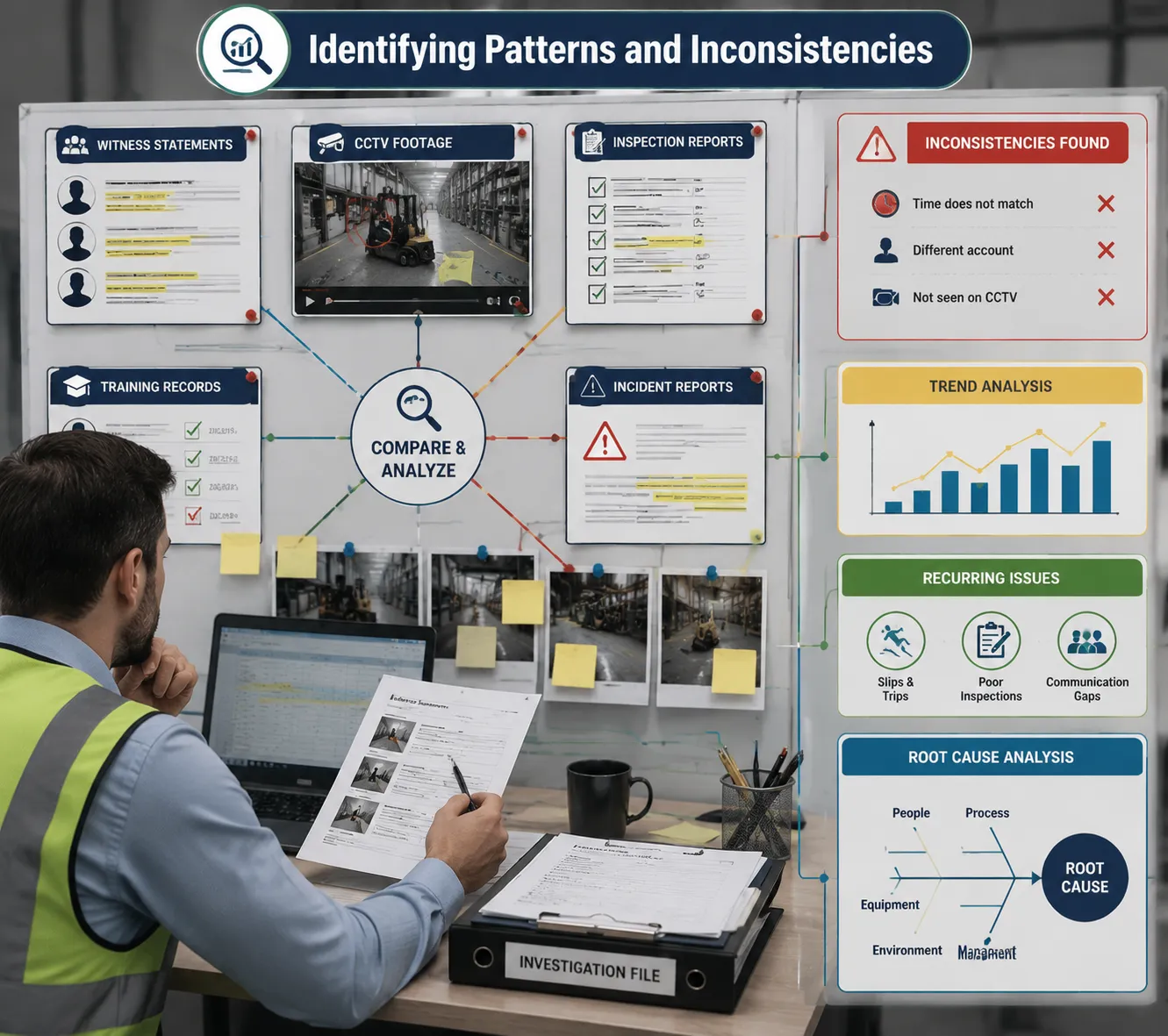
One of the most important stages of any workplace incident or complaint investigation is the analysis of the information collected. During an investigation, information is gathered from multiple sources, including witness statements, interviews, risk assessments, maintenance records, training records, photographs, CCTV footage, inspection reports, and physical evidence. While this information helps investigators understand what happened, it is not uncommon for discrepancies, contradictions, or inconsistencies to emerge. Identifying and evaluating these inconsistencies is essential to ensure that investigation findings are accurate, objective, and evidence-based.
In addition to identifying inconsistencies, investigators must also look for common and recurring themes. A single incident may appear isolated; however, a thorough review often reveals patterns that indicate wider organisational weaknesses. Recurring issues such as inadequate training, poor communication, insufficient supervision, defective equipment, or repeated procedural failures can signal underlying problems within the health and safety management system. Recognising these themes allows organisations to implement long-term corrective actions rather than merely addressing immediate symptoms.
Effective analysis of inconsistencies and recurring themes supports continuous improvement, strengthens workplace safety performance, reduces future risks, and enhances organisational learning. It enables investigators to move beyond identifying what happened and focus on understanding why it happened and how future occurrences can be prevented.
Understanding Investigation Inconsistencies
What Are Investigation Inconsistencies?
Investigation inconsistencies occur when information collected from different sources does not align or when evidence contradicts other evidence.
An inconsistency may involve:
- Conflicting witness statements.
- Differences between verbal accounts and written reports.
- Contradictions between physical evidence and witness testimony.
- Inaccurate timelines.
- Missing information.
- Incomplete records.
- Differences between procedures and actual practice.
- Conflicting observations from investigators.
Not all inconsistencies indicate dishonesty. They may result from misunderstanding, memory limitations, communication barriers, stress, or different perspectives of the same event.
Why Identifying Inconsistencies Is Important
Investigators must identify inconsistencies because they can significantly affect the accuracy of findings.
Benefits include:
- Improved investigation accuracy.
- Better root cause identification.
- Enhanced evidence reliability.
- Increased objectivity.
- Fair decision-making.
- Stronger corrective actions.
- Better legal defensibility.
- Improved organisational learning.
Failure to identify inconsistencies can lead to:
- Incorrect conclusions.
- Misidentification of causes.
- Ineffective corrective measures.
- Repeated incidents.
- Loss of employee confidence.
- Legal and regulatory challenges.
Types of Investigation Inconsistencies
Witness Statement Inconsistencies
Different witnesses may provide different accounts of the same incident.
Examples include:
- Different descriptions of events.
- Contradictory timelines.
- Disagreement regarding actions taken.
- Conflicting observations of hazards.
Possible reasons:
- Different viewing positions.
- Stress or shock.
- Memory limitations.
- Misunderstanding.
- Communication difficulties.
Documentary Inconsistencies
Documents may contain conflicting information.
Examples include:
- Training records showing completion of training while employees report receiving no training.
- Inspection reports indicating equipment is safe while maintenance records reveal ongoing defects.
- Risk assessments that do not reflect actual workplace conditions.
Physical Evidence Inconsistencies
Physical evidence may contradict statements or documentation.
Examples include:
- CCTV footage showing different events than those reported.
- Equipment damage inconsistent with witness accounts.
- Site conditions differing from documented inspections.
Procedural Inconsistencies
These occur when workplace practices differ from approved procedures.
Examples include:
- Employees bypassing safety controls.
- Failure to follow permit-to-work systems.
- Non-compliance with safe systems of work.
- Unauthorised shortcuts.
Common Causes of Investigation Inconsistencies
Human Factors
Human factors often contribute to inconsistencies.
Common examples include:
- Fatigue.
- Stress.
- Anxiety.
- Fear of blame.
- Poor memory recall.
- Miscommunication.
- Personal bias.
Organisational Factors
Organisational weaknesses can create conflicting information.
Examples include:
- Poor record keeping.
- Outdated procedures.
- Inadequate communication.
- Insufficient supervision.
- Inconsistent training practices.
Environmental Factors
Environmental conditions may affect the reliability of information.
Examples include:
- Poor lighting.
- Excessive noise.
- Restricted visibility.
- Adverse weather conditions.
- Workplace distractions.
Process for Identifying Investigation Inconsistencies
Step 1: Review All Available Evidence
Investigators should carefully examine every source of information.
Sources may include:
- Witness statements.
- Interview records.
- Risk assessments.
- Inspection reports.
- CCTV footage.
- Training records.
- Maintenance logs.
- Incident reports.
Step 2: Compare Information Sources
Information should be compared systematically.
Questions include:
- Do witness accounts align?
- Does physical evidence support verbal accounts?
- Are timelines consistent?
- Do documents support observed practices?
Step 3: Verify Contradictions
Where inconsistencies are identified, further investigation may be required.
Verification methods include:
- Additional interviews.
- Further site inspections.
- Document reviews.
- Expert consultation.
- Evidence testing.
Step 4: Record Findings
All identified inconsistencies should be documented.
Records should include:
- Nature of inconsistency.
- Source of information.
- Investigation actions taken.
- Outcome of verification.
- Final conclusions.
Understanding Common and Recurring Themes
What Are Common Themes?
Common themes are issues that appear repeatedly across multiple incidents, complaints, inspections, or investigations.
Examples include:
- Inadequate training.
- Poor housekeeping.
- Lack of supervision.
- Equipment failures.
- Communication breakdowns.
- Unsafe behaviours.
What Are Recurring Themes?
Recurring themes are repeated patterns that indicate underlying organisational weaknesses.
Recurring themes may involve:
- Repeated manual handling injuries.
- Frequent slips and trips.
- Ongoing maintenance failures.
- Repeated complaints regarding supervision.
- Consistent procedural non-compliance.
Importance of Identifying Recurring Themes
Recognising recurring themes enables organisations to move from reactive management to proactive prevention.
Benefits include:
- Identification of systemic weaknesses.
- Improved risk management.
- Better resource allocation.
- Stronger health and safety culture.
- Reduced incident frequency.
- Enhanced compliance.
- Continuous improvement.
Table: Common Investigation Inconsistencies and Recurring Themes
| Issue Type | Definition | Example | Potential Impact |
|---|---|---|---|
| Witness Inconsistency | Conflicting accounts from witnesses | Different descriptions of an accident | Incorrect conclusions |
| Documentary Inconsistency | Records contradict actual conditions | Training record exists but employee lacks knowledge | Competency concerns |
| Physical Evidence Conflict | Physical evidence differs from reports | CCTV contradicts witness statement | Reliability issues |
| Procedural Inconsistency | Work differs from approved procedure | Safety steps bypassed | Increased risk |
| Training Theme | Repeated training-related concerns | Multiple incidents involve untrained workers | Increased accidents |
| Communication Theme | Ongoing communication failures | Workers unaware of hazards | Poor safety performance |
| Supervision Theme | Repeated lack of oversight | Unsafe behaviour continues unchecked | Compliance failures |
| Equipment Theme | Frequent machinery-related incidents | Recurring equipment breakdowns | Operational disruption |
Methods for Identifying Recurring Themes
Trend Analysis
Trend analysis involves examining multiple incidents over time.
Investigators should review:
- Incident reports.
- Complaint records.
- Audit findings.
- Inspection reports.
- Near-miss reports.
Data Analysis
Data can reveal patterns that may not be immediately visible.
Useful indicators include:
- Incident frequency.
- Injury types.
- Location data.
- Time trends.
- Departmental performance.
Root Cause Analysis
Root cause analysis helps identify common underlying causes.
Common root causes include:
- Inadequate procedures.
- Poor supervision.
- Training deficiencies.
- Equipment design issues.
- Organisational culture problems.
Practical Example
Scenario
A manufacturing company experiences several hand injuries over a six-month period.
Initial investigations treat each injury as an isolated event. However, a review of all incidents reveals several recurring themes:
- Employees bypassing machine guards.
- Inadequate supervision during night shifts.
- Delayed maintenance repairs.
- Inconsistent training for temporary workers.
By identifying these recurring themes, the organisation implements:
- Enhanced supervision.
- Improved maintenance procedures.
- Refresher training programmes.
- Stronger machine safeguarding controls.
As a result, injury rates decrease significantly.
Case Study: Warehouse Safety Investigation
Background
A large warehouse reported multiple incidents involving forklift and pedestrian interactions. Although no serious injuries occurred, management became concerned about the increasing frequency of near misses.
Investigation Findings
Investigators reviewed:
- Witness statements.
- CCTV footage.
- Risk assessments.
- Training records.
- Inspection reports.
Several inconsistencies emerged. Some employees reported designated pedestrian routes were available, while others stated routes were frequently blocked by stored materials. CCTV footage confirmed that pedestrian walkways were regularly obstructed despite inspection reports indicating compliance.
The investigation also identified recurring themes:
- Poor housekeeping.
- Inadequate traffic management.
- Inconsistent supervision.
- Failure to report hazards.
Corrective Actions
The organisation implemented:
- Revised traffic management plans.
- Increased workplace inspections.
- Supervisor accountability measures.
- Employee awareness campaigns.
- Improved hazard reporting procedures.
Identifying inconsistencies and recurring themes is a critical component of workplace investigations. Inconsistencies help investigators test the reliability and accuracy of information, while recurring themes reveal underlying organisational weaknesses that may contribute to repeated incidents. By systematically reviewing evidence, comparing information sources, verifying contradictions, and analysing patterns, organisations can develop effective corrective actions that address both immediate concerns and long-term safety challenges. This approach strengthens workplace safety performance, promotes continuous improvement, and supports a proactive health and safety culture.
4. Prepare a Report Containing Details of Incidents and Complaints and Forward to Those Requesting It in the Agreed Format, Timescale and Accordance with Regulatory and Workplace Requirements
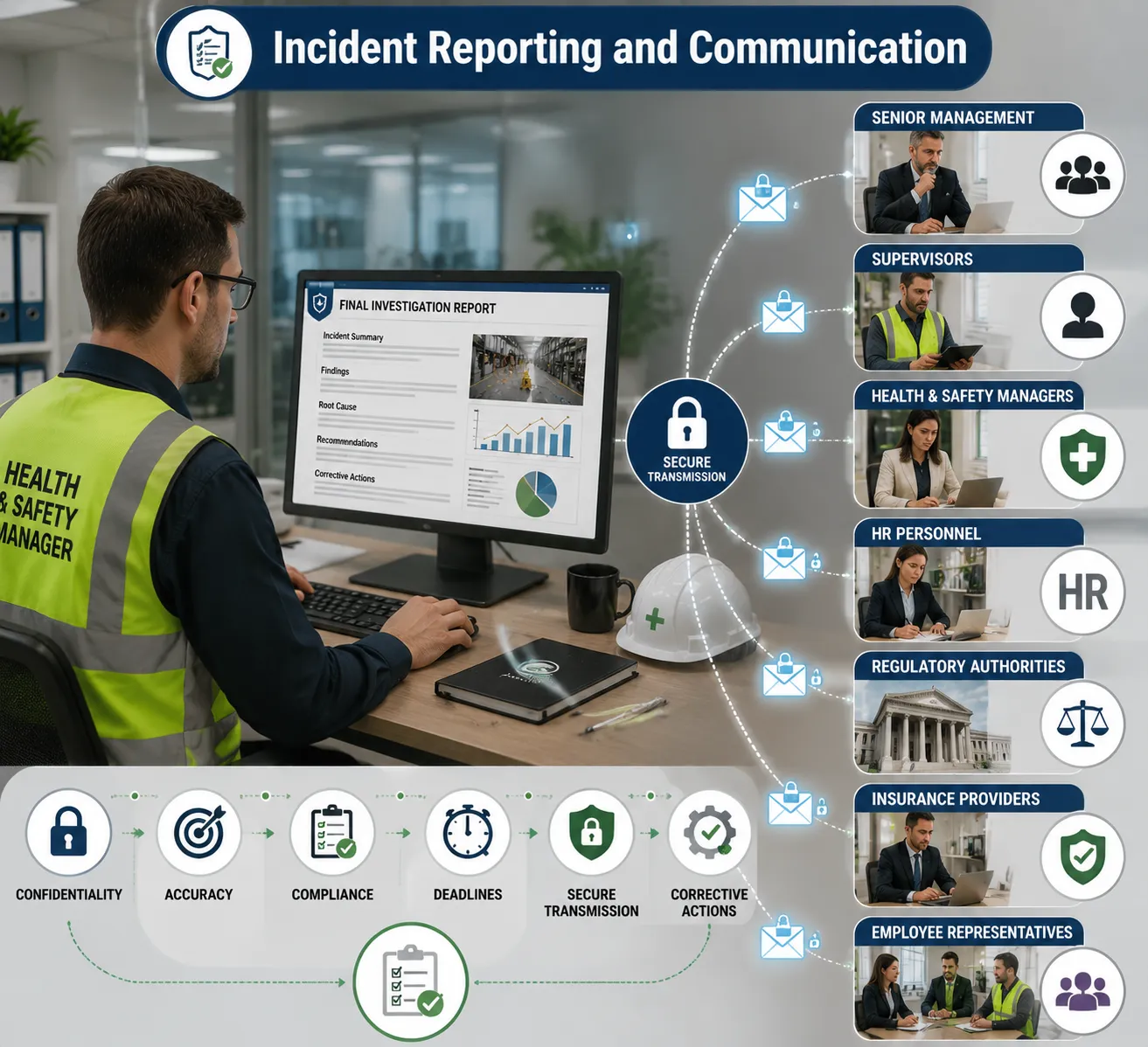
The preparation of accurate and comprehensive incident and complaint reports is a critical component of workplace health and safety management. Once an investigation has been completed and evidence has been analysed, the findings must be documented in a clear, structured, and professional report. These reports provide a formal record of what occurred, the factors that contributed to the incident or complaint, the investigation findings, and any recommendations for corrective or preventive action.
Incident and complaint reports serve multiple purposes within an organisation. They help management make informed decisions, support legal and regulatory compliance, provide evidence during audits or inspections, and contribute to continuous improvement initiatives. A well-prepared report enables stakeholders to understand the circumstances of an incident and ensures that lessons learned are communicated effectively throughout the organisation.
Health and safety professionals must ensure that reports are prepared according to workplace procedures, legal requirements, and organisational standards. Reports should be submitted within agreed timescales and in the required format to ensure timely action and compliance with internal and external reporting obligations.
Understanding Incident and Complaint Reporting
What Is an Incident Report?
An incident report is a formal document that records details of a workplace event, accident, injury, near miss, dangerous occurrence, occupational illness, or other health and safety-related matter.
The report provides:
- A factual account of events.
- Evidence gathered during the investigation.
- Findings and conclusions.
- Corrective action recommendations.
- Documentation for future reference.
What Is a Complaint Report?
A complaint report documents concerns raised by employees, contractors, visitors, customers, or other stakeholders regarding workplace health and safety matters.
Examples include:
- Unsafe working conditions.
- Inadequate safety controls.
- Harassment affecting wellbeing.
- Unsafe behaviour.
- Failure to follow procedures.
- Environmental concerns.
Purpose of Incident and Complaint Reports
Effective reports help organisations:
- Identify causes of incidents.
- Improve workplace safety.
- Meet legal obligations.
- Demonstrate due diligence.
- Support management decisions.
- Monitor trends.
- Prevent recurrence.
- Promote accountability.
Importance of Accurate Reporting
Why Accuracy Matters
Investigation reports must be based on facts and evidence rather than assumptions or opinions.
Accurate reporting helps:
- Ensure reliability of findings.
- Maintain professional credibility.
- Support legal compliance.
- Protect organisational reputation.
- Facilitate corrective actions.
- Improve safety performance.
Risks of Inaccurate Reporting
Poor-quality reports may result in:
- Incorrect conclusions.
- Ineffective corrective actions.
- Repeated incidents.
- Regulatory penalties.
- Legal disputes.
- Loss of trust.
Key Principles of Effective Report Writing
Objectivity
Reports should be factual and unbiased.
Investigators should:
- Present evidence objectively.
- Avoid personal opinions.
- Focus on facts.
- Use neutral language.
- Support findings with evidence.
Clarity
Reports should be easy to understand.
Good practice includes:
- Simple language.
- Logical structure.
- Clear headings.
- Concise explanations.
- Consistent terminology.
Completeness
Reports must contain all relevant information.
This includes:
- Incident details.
- Investigation findings.
- Evidence collected.
- Contributing factors.
- Recommendations.
Confidentiality
Sensitive information must be protected.
Investigators should:
- Follow data protection requirements.
- Restrict access where appropriate.
- Protect personal information.
- Maintain confidentiality throughout the process.
Information That Should Be Included in Incident Reports
Basic Incident Information
The report should include:
- Date of incident.
- Time of incident.
- Location.
- Incident reference number.
- Type of incident.
Details of Individuals Involved
Relevant details may include:
- Employee name.
- Job title.
- Department.
- Contact information.
- Witness information.
Description of Events
A detailed description should explain:
- What happened.
- Where it happened.
- How it happened.
- Activities taking place.
- Equipment involved.
Investigation Findings
The report should summarise:
- Evidence collected.
- Witness statements.
- Physical observations.
- Root causes.
- Contributing factors.
Recommendations
Recommendations may include:
- Additional training.
- Equipment improvements.
- Procedure updates.
- Increased supervision.
- Risk assessment reviews.
Structure of an Incident Investigation Report
Executive Summary
Provides a brief overview of:
- Incident details.
- Key findings.
- Recommendations.
Background Information
Explains:
- Workplace context.
- Relevant activities.
- Existing controls.
Investigation Methodology
Describes:
- Information sources used.
- Interviews conducted.
- Documents reviewed.
- Evidence examined.
Findings
Presents:
- Facts established.
- Evidence analysis.
- Identified causes.
Recommendations
Outlines actions required to prevent recurrence.
Conclusion
Summarises key outcomes and lessons learned.
Table: Key Components of an Effective Incident and Complaint Report
| Component | Definition | Purpose | Example |
|---|---|---|---|
| Incident Details | Basic information about the event | Establish facts | Date, time, location |
| Witness Statements | Accounts from those involved | Clarify events | Employee observations |
| Evidence Summary | Overview of evidence gathered | Support findings | CCTV footage reviewed |
| Root Cause Analysis | Identification of underlying causes | Prevent recurrence | Training deficiency identified |
| Recommendations | Suggested corrective actions | Improve safety | Refresher training programme |
| Complaint Details | Description of concern raised | Address workplace issues | Unsafe working condition reported |
| Action Plan | Agreed improvement measures | Track progress | Equipment inspection schedule |
| Conclusion | Summary of investigation outcomes | Communicate findings | Incident prevention measures |
Regulatory Requirements for Reporting
Legal Compliance
Organisations may have legal obligations regarding reporting and record keeping.
Reports may be required for:
- Workplace injuries.
- Dangerous occurrences.
- Occupational diseases.
- Serious incidents.
- Environmental events.
Internal Policies
Workplace procedures often specify:
- Reporting formats.
- Approval processes.
- Submission requirements.
- Retention periods.
- Confidentiality arrangements.
Industry Standards
Many organisations follow industry-specific requirements relating to:
- Safety management systems.
- Audit processes.
- Compliance monitoring.
- Risk management.
Agreed Reporting Formats
Why Standardised Formats Are Important
Using approved report templates provides consistency.
Benefits include:
- Easier review.
- Improved accuracy.
- Better record keeping.
- Regulatory compliance.
- Efficient communication.
Common Reporting Formats
Organisations may use:
- Incident report forms.
- Investigation reports.
- Digital reporting systems.
- Complaint management forms.
- Safety management software.
Meeting Agreed Timescales
Importance of Timely Reporting
Reports should be completed promptly.
Benefits include:
- Preservation of evidence.
- Faster corrective action.
- Improved compliance.
- Better communication.
- Reduced risk of recurrence.
Factors Affecting Timescales
Factors may include:
- Severity of incident.
- Complexity of investigation.
- Availability of evidence.
- Number of individuals involved.
- Regulatory requirements.
Consequences of Delayed Reporting
Delays may result in:
- Lost evidence.
- Reduced witness recall.
- Increased legal risks.
- Missed compliance deadlines.
- Delayed corrective actions.
Forwarding Reports to Relevant Stakeholders
Who May Receive Investigation Reports?
Once an incident or complaint investigation has been completed, the final report must be distributed to the appropriate individuals or organisations that require the information for decision-making, compliance, corrective action implementation, or legal purposes. The recipients of a report will depend on the nature, severity, and regulatory requirements associated with the incident or complaint.
Senior Management
Senior management may receive investigation reports to:
- Review significant health and safety incidents.
- Monitor organisational safety performance.
- Make strategic decisions regarding risk management.
- Approve corrective and preventive actions.
- Allocate resources for safety improvements.
- Ensure compliance with organisational policies and legal obligations.
Supervisors and Line Managers
Supervisors and line managers are often responsible for implementing recommendations arising from investigations. They may receive reports to:
- Understand the circumstances surrounding an incident.
- Address unsafe practices within their departments.
- Implement corrective actions.
- Monitor employee compliance with safety procedures.
- Prevent similar incidents from recurring.
Health and Safety Managers and Practitioners
Health and safety professionals require investigation reports to:
- Monitor workplace safety performance.
- Analyse incident trends and recurring issues.
- Review the effectiveness of existing control measures.
- Update risk assessments and safe systems of work.
- Ensure compliance with health and safety legislation.
- Support continuous improvement initiatives.
Human Resources Personnel
Human resources departments may receive reports when incidents or complaints involve employee welfare, conduct, wellbeing, or employment-related matters. Their involvement may include:
- Managing employee support and welfare arrangements.
- Addressing workplace grievances or complaints.
- Coordinating return-to-work programmes.
- Managing disciplinary or performance-related matters where appropriate.
- Maintaining employment records.
Regulatory Authorities
Certain incidents must be reported to regulatory bodies in accordance with legal requirements. Regulatory authorities may receive reports to:
- Verify compliance with health and safety legislation.
- Review investigation findings.
- Conduct inspections or audits.
- Determine whether enforcement action is required.
- Monitor workplace safety standards within specific industries.
Insurance Providers
Insurance companies may require copies of investigation reports when incidents result in injury, property damage, business interruption, or potential claims. Reports help insurers:
- Assess liability.
- Process claims.
- Evaluate incident circumstances.
- Determine financial implications.
- Support claim investigations.
Employee Representatives and Safety Representatives
Employee representatives may receive relevant information from investigation reports to:
- Support employee welfare and wellbeing.
- Promote transparency within the workplace.
- Participate in health and safety consultations.
- Assist in the development of preventive measures.
- Encourage workforce engagement in safety initiatives.
Legal Advisors and External Consultants
In some situations, reports may also be shared with legal advisers, auditors, consultants, or specialist investigators to:
- Obtain professional advice.
- Support legal proceedings.
- Conduct independent reviews.
- Assess compliance with regulatory requirements.
- Provide expert recommendations.
Communication Considerations When Forwarding Reports
The effectiveness of an investigation report depends not only on its content but also on how it is communicated and distributed. Reports must be handled professionally to protect sensitive information, maintain confidentiality, and ensure that stakeholders receive accurate information in a timely manner.
Secure Transmission of Reports
Investigation reports often contain sensitive organisational and personal information. Therefore, reports should be transmitted using secure methods to prevent unauthorised access.
Examples include:
- Secure electronic document management systems.
- Password-protected files.
- Encrypted emails.
- Restricted-access databases.
- Secure physical document storage and delivery systems.
Secure transmission helps:
- Protect confidential information.
- Prevent data breaches.
- Maintain organisational integrity.
- Comply with data protection requirements.
Maintaining Confidentiality
Confidentiality is a fundamental requirement during the reporting process. Reports may contain personal information, witness statements, medical information, and sensitive organisational data.
Good confidentiality practices include:
- Limiting access to authorised individuals only.
- Redacting sensitive information where appropriate.
- Protecting witness identities when necessary.
- Following organisational confidentiality policies.
- Complying with data protection and privacy regulations.
Maintaining confidentiality helps build trust and encourages employees to cooperate fully with future investigations.
Ensuring Accuracy and Completeness
Before a report is distributed, it should be carefully reviewed to ensure that it is accurate, objective, and complete.
The report should:
- Contain verified information.
- Present facts clearly and objectively.
- Include all relevant evidence.
- Accurately reflect investigation findings.
- Clearly identify recommendations and actions required.
- Be free from errors and omissions.
Accurate reporting supports effective decision-making and reduces the risk of misunderstandings or disputes.
Meeting Agreed Timescales
Reports should be completed and submitted within the timescales specified by workplace procedures or regulatory requirements.
Timely reporting is important because it:
- Enables prompt corrective action.
- Supports legal compliance.
- Preserves investigation credibility.
- Reduces the likelihood of recurring incidents.
- Ensures stakeholders receive information when it is most useful.
Failure to meet reporting deadlines may result in:
- Delayed safety improvements.
- Regulatory non-compliance.
- Increased organisational risk.
- Loss of confidence in the investigation process.
Distribution to Authorised Persons Only
Investigation reports should only be shared with individuals who have a legitimate need to access the information.
This includes:
- Management personnel.
- Health and safety professionals.
- Relevant supervisors.
- Regulatory authorities where required.
- Human resources personnel where appropriate.
Restricting access helps:
- Protect confidentiality.
- Prevent misuse of information.
- Maintain legal compliance.
- Ensure professional handling of sensitive data.
Clear Communication of Findings and Recommendations
When forwarding reports, investigators should ensure that recipients understand the findings and any actions required.
Effective communication may involve:
- Providing executive summaries.
- Highlighting key findings.
- Identifying priority actions.
- Clarifying responsibilities.
- Establishing implementation deadlines.
- Arranging follow-up discussions where necessary.
This helps ensure that investigation outcomes lead to meaningful improvements in workplace health and safety performance.
Practical Example
Scenario
An employee slips on a wet floor and sustains a minor injury.
The investigator prepares a report containing:
- Incident details.
- Witness statements.
- Photographs.
- Risk assessment review.
- Root cause analysis.
The report identifies inadequate housekeeping procedures as the primary cause. Recommendations include enhanced cleaning schedules and improved hazard signage.
The completed report is submitted to management within the organisation’s required reporting timeframe and retained within the safety management system.
Case Study: Workplace Complaint Investigation
Background
Several employees submitted complaints regarding excessive noise levels in a manufacturing area. Management initiated a formal investigation.
Investigation Activities
The investigation included:
- Employee interviews.
- Noise monitoring.
- Workplace inspections.
- Review of previous complaints.
- Examination of maintenance records.
Findings
The investigation identified:
- Defective machinery components.
- Inadequate noise monitoring.
- Delayed maintenance activities.
- Insufficient employee communication.
Recommendations
The report recommended:
- Immediate machinery repairs.
- Updated maintenance schedules.
- Noise monitoring programme.
- Employee awareness training.
The final report was prepared using the organisation’s approved format and submitted within the required timeframe. Management implemented the recommendations, resulting in improved working conditions and reduced employee complaints. This demonstrates the importance of preparing comprehensive reports and forwarding them to relevant stakeholders in accordance with workplace and regulatory requirements.