
Occupational Health and Safety Risk Assessment: Complete Guide
Occupational health and safety risk assessment is one of the most important processes organizations can use to identify workplace hazards, protect employees, and prevent injuries and occupational illnesses.
A proper risk assessment does much more than identify obvious dangers such as machinery, electrical equipment, or slippery floors. It should also consider chemical exposure, noise, vibration, biological hazards, ergonomic problems, psychosocial risks, fatigue, heat, radiation, and other conditions that can affect workers’ health over time.
The goal is straightforward:
Identify hazards → Understand exposure → Evaluate risk → Apply controls → Verify effectiveness → Review and improve
A risk assessment should reflect the workplace as it actually operates, rather than simply documenting how work is supposed to happen according to a procedure.
Organizations and individuals looking to strengthen their occupational health and safety knowledge can also explore professional health and safety training and certifications to develop relevant skills and support their professional development.
What is an Occupational Health and Safety Risk Assessment?
An occupational health and safety risk assessment is a systematic process used to identify hazards in the workplace, determine who may be exposed, evaluate the potential for harm, and decide what measures are necessary to eliminate or reduce the risk.
The process can be relatively simple for a low-risk office activity or highly technical for environments involving hazardous chemicals, heavy machinery, radiation, biological agents, confined spaces, or complex industrial processes.
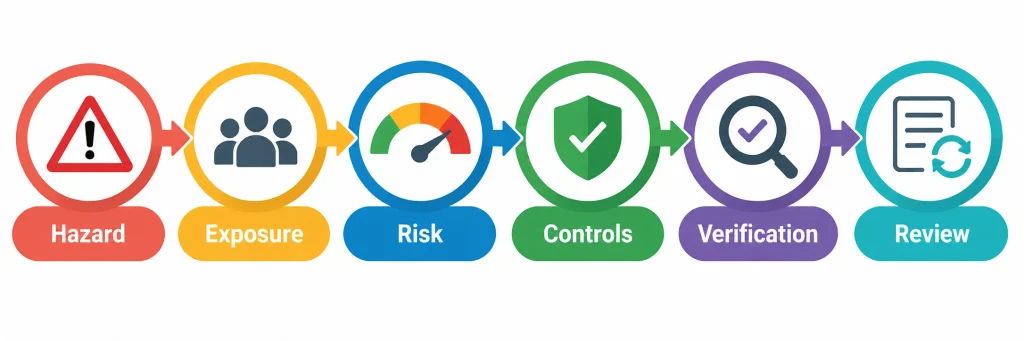
A useful risk assessment answers several fundamental questions:
| Question | What it determines |
|---|---|
| What is the hazard? | Identifies the source of potential harm |
| Who may be exposed? | Identifies affected workers and other people |
| How could harm occur? | Determines the exposure or incident pathway |
| How serious could the outcome be? | Establishes potential consequence |
| How likely is it to occur? | Helps prioritize the risk |
| What controls already exist? | Determines current protection |
| Are existing controls effective? | Identifies weaknesses |
| What additional controls are needed? | Defines corrective action |
| Who is responsible? | Creates accountability |
| When should it be reviewed? | Keeps the assessment current |
Hazard vs. Risk
The terms hazard and risk are often used interchangeably, but they describe different concepts.
A hazard is something that has the potential to cause harm.
A risk relates to the possibility and potential consequences of that harm occurring under particular circumstances.
For example:
- A chemical with toxic properties is a hazard.
- A worker repeatedly inhaling vapors from that chemical represents an exposure scenario.
- The likelihood and potential health consequences associated with that exposure contribute to the risk.
This distinction is especially important in occupational health because some hazards produce immediate injuries while others can contribute to health problems after prolonged or repeated exposure.
Why is Risk Assessment Important?
A workplace risk assessment allows an organization to take a proactive approach to occupational health and safety.
Instead of waiting for an accident or illness to reveal a problem, employers can identify hazards and introduce controls beforehand.
A good risk assessment can help organizations:
- Prevent workplace injuries
- Reduce occupational illnesses
- Identify hidden hazards
- Improve working conditions
- Prioritize corrective actions
- Improve emergency preparedness
- Strengthen safety procedures
- Support worker participation
- Improve management of change
- Demonstrate a structured approach to risk control
Risk Assessment is More Than Accident Prevention
A common mistake is to focus only on hazards that could cause an immediate accident.
Occupational health requires a wider perspective.
| Hazard category | Example | Possible impact |
|---|---|---|
| Physical | Excessive noise | Hearing damage |
| Chemical | Solvent vapor | Respiratory or systemic effects |
| Biological | Infectious agent | Occupational infection |
| Ergonomic | Repetitive lifting | Musculoskeletal disorders |
| Psychosocial | Excessive workload | Stress, fatigue, reduced well-being |
| Thermal | Extreme heat | Heat-related illness |
| Radiation | Ionizing radiation | Tissue or cellular damage |
| Mechanical | Unguarded machinery | Cuts, crushing, amputation |
A workplace can have few reported accidents and still contain significant occupational health risks.
That is why a comprehensive assessment needs to consider both immediate safety hazards and longer-term health exposures.
Occupational Health Risk Assessment vs. Safety Risk Assessment
Although occupational health and occupational safety are closely connected, their risk profiles can differ.
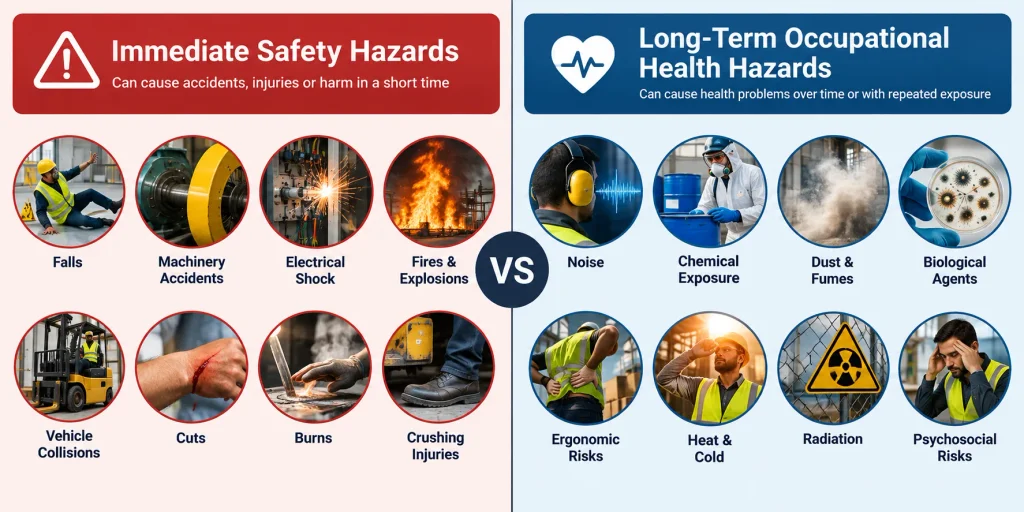
Occupational Safety
Safety assessments often focus on events that can cause immediate or relatively rapid harm.
Examples include:
- Falls
- Machinery accidents
- Electrical shock
- Fires
- Explosions
- Vehicle collisions
- Cuts
- Burns
- Crushing injuries
Occupational Health
Health assessments often focus on exposures that may cause illness over time.
Examples include:
- Chemical exposure
- Noise
- Vibration
- Dust
- Biological agents
- Radiation
- Poor ergonomics
- Heat
- Fatigue
- Psychosocial hazards
Why Both Matter
| Safety question | Health question |
|---|---|
| Could someone fall? | Could repeated exposure cause illness? |
| Could machinery injure someone? | Could vibration affect workers over time? |
| Could an electrical fault cause injury? | Could chemical exposure affect health? |
| Could a fire occur? | Could heat exposure cause illness? |
A strong OH&S risk assessment considers both dimensions.
Read our guide on Occupational Health and Safety: Complete Workplace Safety Guide 2026
The Occupational Health and Safety Risk Assessment Process
A practical assessment can be organized into the following stages:
- Define the activity or workplace
- Identify hazards
- Identify people who may be exposed
- Understand exposure and potential harm
- Evaluate the level of risk
- Review existing controls
- Select additional controls
- Assign responsibility
- Verify control effectiveness
- Review and update the assessment
The process is not necessarily linear. New information discovered during one stage may require the assessor to return to an earlier stage.
Step 1: Define the Activity or Workplace
Before identifying hazards, clearly define what is being assessed.
Avoid creating assessments that are so broad that important details become hidden.
For example, instead of creating one assessment called:
“Manufacturing Risk Assessment”
break the workplace into relevant activities such as:
- Raw material handling
- Machine operation
- Chemical cleaning
- Maintenance
- Packaging
- Warehouse operations
- Forklift movement
- Waste handling
- Emergency response
This allows the assessor to examine the hazards associated with each activity in greater detail.
Consider the Full Work Cycle
Do not assess only normal production.
Consider:
- Startup
- Normal operation
- Shutdown
- Cleaning
- Maintenance
- Equipment failure
- Changeovers
- Emergency situations
- Contractor activities
- Temporary work
- Unusual or infrequent tasks
Many significant hazards appear outside normal operating conditions.
Step 2: Identify Workplace Hazards
Hazard identification is the foundation of the entire assessment.
The objective is to identify anything that could cause injury, illness, or other harm.
Common Workplace Hazard Categories
| Category | Examples |
|---|---|
| Physical | Noise, vibration, heat, cold, radiation |
| Mechanical | Moving machinery, rotating parts, pinch points |
| Electrical | Exposed conductors, faulty equipment, electrical energy |
| Chemical | Solvents, gases, vapors, dusts, fumes |
| Biological | Bacteria, viruses, fungi, biological materials |
| Ergonomic | Repetition, lifting, awkward posture, force |
| Psychosocial | Workload, violence, harassment, fatigue |
| Environmental | Poor ventilation, lighting, temperature |
| Fire | Ignition sources, combustible materials |
| Traffic | Forklifts, vehicles, pedestrian interaction |
| Work at height | Ladders, scaffolds, elevated platforms |
| Confined space | Limited access, atmospheric hazards |
Where Should You Look for Hazards?
Hazard information can come from multiple sources:
- Workplace inspections
- Employee interviews
- Safety data sheets
- Equipment manuals
- Maintenance records
- Incident reports
- Near-miss reports
- Occupational hygiene measurements
- Previous risk assessments
- Health and safety complaints
- Regulatory requirements
- Manufacturer information
- Job observations
Step 3: Identify Who May Be Harmed
A risk assessment should identify people, not just hazards.
Potentially affected groups may include:
- Employees
- Contractors
- Temporary workers
- Maintenance teams
- Visitors
- Delivery drivers
- Cleaners
- Security personnel
- New workers
- Young workers
- Workers performing unusual tasks
- Members of the public
For each group, consider:
How could they be exposed?
How frequently could exposure occur?
Are their tasks different from those of other workers?
Do they require additional controls or information?
Example
A forklift operating in a warehouse may create risks for:
- Forklift operators
- Pedestrians
- Maintenance workers
- Delivery personnel
- Contractors
- Visitors
The assessment should therefore consider the entire interaction between vehicles and people, rather than assessing the forklift operator alone.
Step 4: Understand Exposure and Potential Harm
This stage is particularly important for occupational health risk assessment.
For each hazard, consider:
- Exposure route
- Exposure duration
- Exposure frequency
- Exposure intensity
- Number of workers exposed
- Existing controls
- Potential health effects
- Whether exposure can be measured
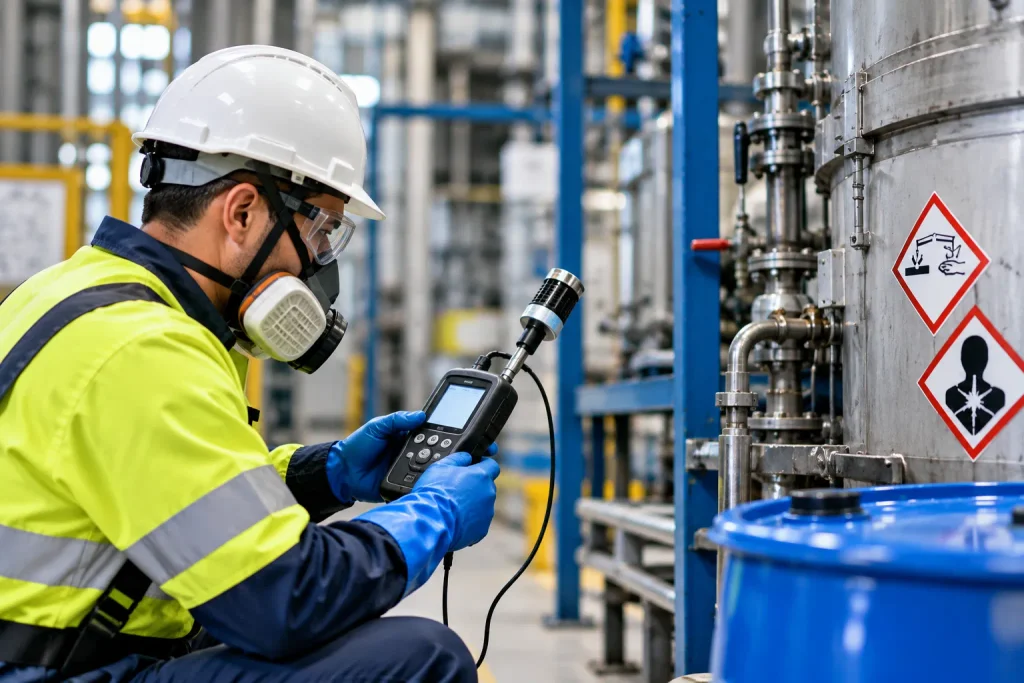
Common Exposure Routes
For chemical hazards, exposure can occur through:
- Inhalation
- Skin contact
- Eye contact
- Ingestion
- Injection through injury
For physical hazards, exposure may involve:
- Noise
- Vibration
- Radiation
- Heat
- Cold
For ergonomic hazards, consider:
- Force
- Repetition
- Duration
- Posture
- Frequency
- Recovery time
The existence of a hazard does not tell you everything about the risk. Exposure conditions matter.
Step 5: Evaluate the Risk
After identifying the hazard and exposure scenario, evaluate the risk.
A common approach is:
Risk = Likelihood × Severity
For example:
| Factor | Rating |
|---|---|
| Likelihood | 4 |
| Severity | 5 |
| Risk score | 20 |
Organizations can establish their own scoring criteria.
Example 5×5 Risk Matrix
| Likelihood / Severity | 1 | 2 | 3 | 4 | 5 |
|---|---|---|---|---|---|
| 1 – Rare | 1 | 2 | 3 | 4 | 5 |
| 2 – Unlikely | 2 | 4 | 6 | 8 | 10 |
| 3 – Possible | 3 | 6 | 9 | 12 | 15 |
| 4 – Likely | 4 | 8 | 12 | 16 | 20 |
| 5 – Almost certain | 5 | 10 | 15 | 20 | 25 |
The organization should define what each range means.
For example:
| Score | Example classification | Typical response |
|---|---|---|
| 1–4 | Low | Maintain controls and monitor |
| 5–9 | Moderate | Consider additional controls |
| 10–16 | High | Prioritize corrective action |
| 17–25 | Very high | Immediate management attention |
These categories are examples, not universal requirements. Organizations should establish criteria appropriate to their operations and applicable requirements.
Important Limitation of Risk Matrices
A risk matrix is a decision-support tool, not a substitute for technical assessment.
For some occupational health hazards, a simple likelihood × severity score may not adequately characterize exposure.
For example, chemical exposure may require:
- Exposure monitoring
- Air sampling
- Occupational hygiene expertise
- Toxicological information
- Relevant exposure limits
- Dose-response information
Step 6: Evaluate Existing Controls
Before recommending new measures, determine what controls already exist.
Ask:
- Is the control actually installed?
- Is it being used?
- Is it maintained?
- Is it suitable for the hazard?
- Does it work under normal conditions?
- Does it work during abnormal conditions?
- Do workers understand it?
- Has its effectiveness been verified?
Example
Suppose a machine has a physical guard.
Do not simply record:
Existing control: Machine guard.
Instead ask:
- Can workers reach the danger zone?
- Is the guard secure?
- Can it be easily removed?
- Does the machine stop when the guard is opened?
- Is the guard inspected?
- Is it bypassed during maintenance?
- Are replacement parts available?
A control that exists on paper but fails in practice should not be treated as an effective control.
Step 7: Apply the Hierarchy of Controls
Once the existing controls have been evaluated, determine whether additional measures are needed.
The hierarchy of controls generally follows this order:
| Level | Control | Example |
|---|---|---|
| 1 | Elimination | Remove the hazardous task |
| 2 | Substitution | Replace hazardous chemical |
| 3 | Engineering | Enclose equipment |
| 4 | Administrative | Procedures and scheduling |
| 5 | PPE | Gloves, respirators, eye protection |
Example: Chemical Exposure
Imagine workers manually applying a hazardous solvent.
Option 1 — PPE
Provide gloves and respiratory protection.
Option 2 — Administrative control
Limit exposure time and establish procedures.
Option 3 — Engineering control
Use an enclosed application system.
Option 4 — Substitution
Replace the solvent with a less hazardous product.
Option 5 — Elimination
Remove the solvent-based process entirely.
The higher-level controls should be investigated before relying primarily on PPE.
Step 8: Calculate and Manage Residual Risk
After controls are introduced, reassess the hazard.
This creates two useful concepts:
Initial Risk
Risk before additional controls are implemented.
Residual Risk
Risk remaining after controls are implemented.
A simplified assessment might look like this:
| Assessment stage | Likelihood | Severity | Risk |
|---|---|---|---|
| Initial assessment | 4 | 5 | 20 |
| After engineering control | 2 | 5 | 10 |
| After additional measures | 1 | 5 | 5 |
However, do not reduce a risk score simply because controls have been written into the assessment.
The controls need to be implemented and verified.
Control Verification Methods
Depending on the hazard, verification may involve:
- Workplace inspections
- Exposure monitoring
- Noise measurements
- Equipment testing
- Ventilation checks
- Worker interviews
- Maintenance records
- Incident data
- Near-miss information
- Audits
- Observation of work practices
The basic cycle is:
Assess → Control → Verify → Monitor → Reassess
Step 9: Involve Workers in the Assessment
Workers should be involved in risk assessment wherever appropriate.
Why?
Because employees often understand the practical realities of a task better than anyone reviewing documents from outside the work area.
Workers may identify:
- Unsafe shortcuts
- Equipment problems
- Repetitive tasks
- Awkward movements
- Frequent near misses
- Poorly designed procedures
- Difficult PPE
- Unexpected exposure
- Production pressures
- Maintenance problems
Questions to Ask Workers
During an assessment, ask:
What can go wrong during this task?
Which part of the job is most difficult?
Are there tasks you perform differently from the written procedure?
Have you experienced or observed near misses?
Which equipment causes the most problems?
Does the PPE interfere with the job?
What would make this task safer?
Worker participation should be meaningful—not simply a signature at the bottom of a form.
Step 10: Document the Risk Assessment
A professional risk assessment should create a clear record of:
- The activity
- Hazard
- Exposed people
- Potential harm
- Existing controls
- Risk evaluation
- Additional controls
- Responsible person
- Target date
- Verification method
- Residual risk
- Review date
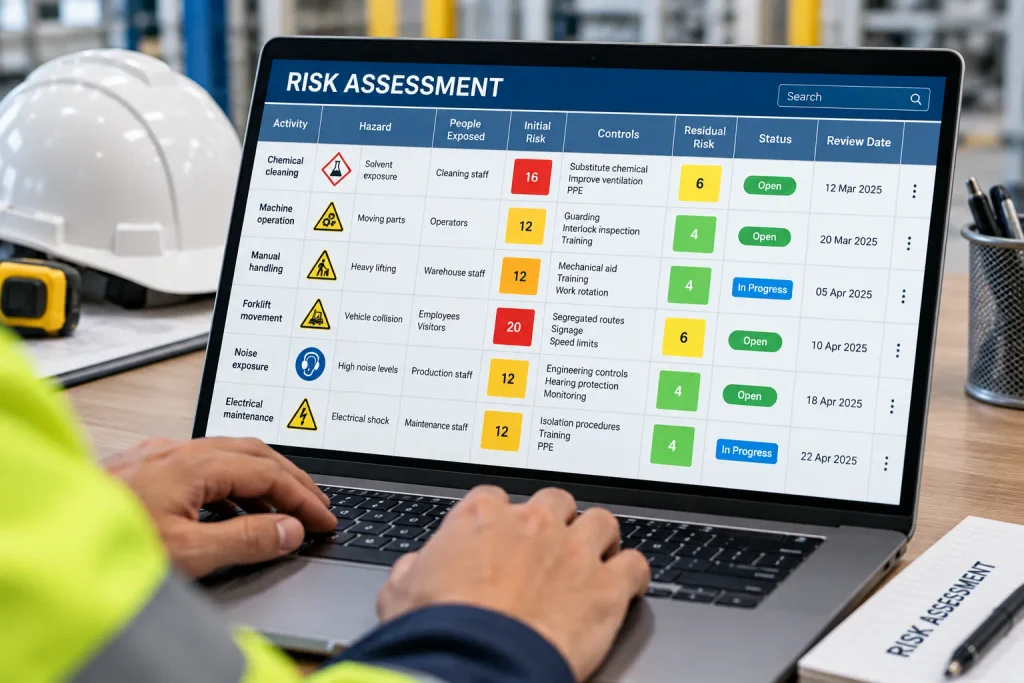
Example Risk Assessment Register
| Activity | Hazard | Potential Harm | Existing Controls | Initial Risk | Additional Control | Owner | Residual Risk |
|---|---|---|---|---|---|---|---|
| Chemical cleaning | Solvent vapor | Respiratory exposure | Ventilation + PPE | 16 | Substitute chemical | HSE Manager | 6 |
| Machine operation | Moving parts | Crushing injury | Guarding | 15 | Interlock inspection | Maintenance | 5 |
| Manual handling | Heavy load | Back injury | Training | 12 | Mechanical lifting aid | Operations | 4 |
| Warehouse traffic | Forklift/pedestrian interaction | Collision | Marked routes | 20 | Physical segregation | Warehouse Manager | 6 |
The exact format can vary, but the assessment should make it obvious what needs to happen next.
Occupational Health and Safety Risk Assessment Example
Let’s look at a practical example involving chemical cleaning.
Scenario
A manufacturing employee cleans production equipment using a solvent several times per week.
Hazard Identification
Hazard: Solvent exposure.
Potential Exposure Routes
- Inhalation
- Skin contact
- Eye contact
People Potentially Exposed
- Production employees
- Cleaning personnel
- Maintenance workers
Risk Factors
The assessment considers:
- Quantity used
- Frequency of use
- Duration of each cleaning task
- Ventilation
- Application method
- Container handling
- Potential for splashing
- Existing PPE
- Existing engineering controls
Control Assessment
| Control level | Possible measure |
|---|---|
| Elimination | Remove solvent-based cleaning |
| Substitution | Use a less hazardous alternative |
| Engineering | Enclosed transfer/application |
| Administrative | Procedures and training |
| PPE | Appropriate gloves and eye protection |
Verification
After controls are implemented, the organization should determine whether the exposure has actually been reduced.
Depending on the hazard and applicable requirements, this may include:
- Exposure monitoring
- Ventilation inspection
- Worker feedback
- Observation
- Equipment inspection
- Review of incidents or symptoms
The assessment is not complete simply because PPE has been issued.
How Often Should a Risk Assessment Be Reviewed?
There is no universal review interval that is appropriate for every workplace.
A risk assessment should be reviewed when the conditions that influence risk change.
Review the Assessment When:
- New machinery is introduced
- A new chemical is purchased
- A production process changes
- Workplace layout changes
- Staffing changes significantly
- New contractors arrive
- Work schedules change
- An incident occurs
- A near miss occurs
- Existing controls fail
- Workers report new concerns
- New hazard information becomes available
- Regulatory requirements change
- New technology is introduced
Important Principle
Do not wait for an accident before reviewing a risk assessment.
A significant change can create a new risk before anyone is injured.
Common Risk Assessment Mistakes
Even organizations with established safety programs can make avoidable mistakes.
1. Treating the Assessment as Paperwork
A completed form does not automatically mean the risk is controlled.
2. Copying an Old Assessment
Previous assessments can provide useful information, but workplace conditions must be verified.
3. Ignoring Occupational Health Hazards
Noise, chemicals, dust, vibration, ergonomics, and psychosocial risks should not be overlooked.
4. Relying Too Heavily on PPE
PPE should not automatically be the first or only control considered.
5. Ignoring Non-Routine Work
Maintenance, cleaning, breakdowns, startup, shutdown, and emergencies can create different hazards.
6. Not Consulting Workers
Employees can provide valuable information about real workplace conditions.
7. Using Risk Scores Without Evidence
A numerical score does not make an assessment accurate by itself.
8. Failing to Assign Responsibility
Every significant corrective action should have an accountable owner.
9. Not Verifying Controls
A documented control should be checked to ensure it works.
10. Never Updating the Assessment
Workplaces change, so risk assessments need to change too.
Occupational Health and Safety Risk Assessment Checklist
Use the following checklist before finalizing an assessment.
Hazard Identification
- Have all relevant activities been reviewed?
- Have normal operations been considered?
- Have non-routine tasks been considered?
- Have emergency situations been considered?
- Have physical hazards been identified?
- Have chemical hazards been identified?
- Have biological hazards been considered?
- Have ergonomic risks been considered?
- Have psychosocial hazards been considered?
People and Exposure
- Have employees been identified?
- Have contractors been considered?
- Have visitors been considered?
- Have potentially vulnerable groups been considered?
- Have exposure routes been identified?
- Has exposure duration been considered?
- Has exposure frequency been considered?
- Is exposure monitoring necessary?
Controls
- Have existing controls been evaluated?
- Has elimination been considered?
- Has substitution been considered?
- Have engineering controls been considered?
- Have administrative controls been considered?
- Has PPE been selected appropriately?
Management
- Have workers participated?
- Have responsibilities been assigned?
- Are deadlines documented?
- Has residual risk been evaluated?
- Is control effectiveness being verified?
- Is a review trigger established?
Risk Assessment Template
A simple workplace risk assessment can use the following structure:
| Field | Information to record |
|---|---|
| Workplace/Department | Where the assessment applies |
| Activity | Task being assessed |
| Hazard | Source of potential harm |
| Exposed people | Who could be affected |
| Exposure | How workers may encounter the hazard |
| Potential harm | Injury or health outcome |
| Existing controls | Current protective measures |
| Likelihood | Probability/exposure rating |
| Severity | Potential consequence |
| Initial risk | Pre-control assessment |
| Additional controls | Further measures required |
| Responsible person | Action owner |
| Target date | Completion deadline |
| Verification | How effectiveness will be checked |
| Residual risk | Remaining risk |
| Review date | Planned review |
| Review trigger | Conditions requiring reassessment |
Use this structure as a starting point rather than a substitute for competent risk assessment.
ISO 45001 and Occupational Health and Safety Risk Assessment
Organizations using ISO 45001 should view risk assessment as part of a broader occupational health and safety management system rather than as an isolated document.
ISO 45001 focuses on establishing, implementing, maintaining, and continually improving an OH&S management system.
In practical terms, risk assessment should connect with activities such as:
- Hazard identification
- Operational planning
- Worker participation
- Competence and awareness
- Emergency preparedness
- Management of change
- Procurement
- Contractor management
- Performance evaluation
- Corrective action
- Continual improvement
This is important because a risk assessment should influence how work is designed and managed, not simply record hazards after decisions have already been made.
Occupational Risk Assessment: When is Specialist Expertise Needed?
Not every workplace assessment requires a specialist for every hazard.
However, some situations require technical expertise.
Consider seeking competent specialist support when dealing with:
- Hazardous chemical exposure
- Industrial hygiene
- Radiation
- Complex machinery
- Confined spaces
- Explosion risks
- Biological hazards
- Noise exposure
- Complex ergonomic risks
- Psychosocial risk programs
- Occupational health surveillance
- High-risk construction activities
For example, determining whether airborne exposure is adequately controlled may require professional industrial hygiene expertise and appropriate monitoring.
Knowing when an assessment exceeds the limits of general workplace inspection is itself an important part of effective risk management.
Risk assessment is not an isolated activity. In many organisations, Health and Safety Managers help coordinate the process, review findings, monitor controls and support corrective actions. Read our guide to Health and Safety Manager roles, responsibilities and skills to understand how these activities fit into wider safety management.
Final Takeaway
An effective occupational health and safety risk assessment is not simply a form, spreadsheet, or risk matrix.
It is a practical process for understanding how work can cause injury or illness and determining how those risks can be prevented or reduced.
The strongest approach combines:
Hazard identification
↓
Exposure assessment
↓
Risk evaluation
↓
Hierarchy of controls
↓
Control implementation
↓
Verification
↓
Residual risk assessment
↓
Continuous review
The process should consider both immediate safety hazards and long-term occupational health risks. It should involve workers, use appropriate technical information, assign responsibility for corrective actions, and verify whether controls actually work.
Most importantly, organizations should avoid treating risk assessment as a once-a-year compliance exercise.
A workplace changes. Equipment changes. Processes change. People change. Exposure changes. Therefore, risk management must change too.
When risk assessment becomes part of everyday operational decision-making, it can help organizations move from reacting to accidents toward preventing harm before it occurs.