
What Does a Health and Safety Manager Do? Roles, Responsibilities and Skills
A Health and Safety Manager helps an organisation identify workplace hazards, assess risks, implement appropriate controls and continually improve occupational health and safety performance. The role can involve much more than conducting workplace inspections. Depending on the organisation, industry and level of responsibility, a Health and Safety Manager may also develop safety policies, coordinate risk assessments, investigate incidents, monitor corrective actions, support training, manage contractors, prepare performance reports and work with senior management.
Health and safety management is an ongoing process rather than a one-off activity. The UK Health and Safety Executive (HSE), for example, describes effective management through a continuous Plan, Do, Check, Act approach, while the International Labour Organization (ILO) promotes a systems-based approach that integrates occupational safety and health into wider organisational management.
What is a Health and Safety Manager?
A Health and Safety Manager is a professional who helps an organisation manage occupational health and safety risks through structured policies, procedures, risk controls, monitoring, communication and improvement activities.
The exact role varies considerably between organisations. A Health and Safety Manager working on a major construction project may have different responsibilities from one working in manufacturing, engineering, logistics, energy, healthcare or facilities management.
In a smaller organisation, one professional may be responsible for a broad range of safety activities. In a large organisation, the Health and Safety Manager may lead a dedicated team and coordinate safety activities across several departments, sites or projects.
At its core, the role involves helping an organisation answer several important questions:
- What could cause harm?
- Who could be affected?
- How significant are the risks?
- What controls are required?
- Are those controls actually being implemented?
- Are they working effectively?
- What needs to improve?
- How should safety information be communicated to workers and management?
A Health and Safety Manager therefore operates at both strategic and practical levels.
What Does a Health and Safety Manager Do?
The responsibilities of a Health and Safety Manager can include:
- Developing and reviewing health and safety policies
- Identifying workplace hazards
- Coordinating and reviewing risk assessments
- Advising on risk control measures
- Developing safe systems of work
- Conducting workplace inspections
- Supporting internal safety audits
- Investigating accidents, incidents and near misses
- Managing corrective actions
- Supporting health and safety training
- Monitoring applicable requirements
- Supporting emergency preparedness
- Monitoring health and safety performance
- Preparing reports for management
- Consulting with workers
- Coordinating contractor safety
- Promoting a positive safety culture
- Supporting continual improvement
However, these responsibilities should not be viewed as separate tasks.
A strong Health and Safety Manager connects them into a continuous management process:
Identify → Assess → Control → Communicate → Monitor → Review → Improve
This systems-based approach is important because controlling a workplace risk is not simply about identifying a hazard once. Controls need to remain effective as workplaces, equipment, processes and people change.
Key Roles and Responsibilities of a Health and Safety Manager
1. Developing Health and Safety Policies
Health and Safety Managers may contribute to developing, implementing and reviewing organisational health and safety policies.
A policy establishes the organisation’s overall approach to protecting workers and others who may be affected by its activities.
Depending on the organisation, the Health and Safety Manager may help:
- Review existing policies
- Identify areas requiring improvement
- Establish safety objectives
- Define responsibilities
- Communicate organisational expectations
- Review policies after significant changes
- Ensure safety considerations are integrated into business activities
A health and safety policy should not simply be a document stored on a computer or displayed on a noticeboard.
It needs to be supported by practical arrangements, appropriate resources, competent people and effective monitoring.
2. Identifying Workplace Hazards
Hazard identification is one of the fundamental activities within health and safety management.
A hazard is something with the potential to cause harm. Depending on the workplace, hazards may include:
- Moving machinery
- Electricity
- Chemicals
- Noise
- Vibration
- Fire
- Working at height
- Confined spaces
- Vehicles
- Manual handling
- Poor workplace conditions
- Biological agents
- Ergonomic factors
- Psychosocial risks
A Health and Safety Manager may identify hazards through:
- Workplace inspections
- Safety observations
- Worker consultation
- Risk assessments
- Incident records
- Near-miss reports
- Equipment reviews
- Process reviews
- Contractor activities
- Changes to working practices
Workers can provide valuable information because they often understand how tasks are actually performed in practice.
For this reason, effective safety management should not rely entirely on management observation. Consultation and worker participation can help organisations identify practical risks and develop controls that are suitable for real working conditions.
3. Conducting and Reviewing Risk Assessments
Risk assessment is another central responsibility.
A Health and Safety Manager may conduct, coordinate or review risk assessments depending on the organisation’s structure and the competence of other personnel.
A practical risk assessment generally involves:
- Identifying hazards
- Determining who could be harmed and how
- Evaluating the risks
- Deciding on suitable controls
- Recording relevant findings
- Implementing the controls
- Reviewing whether the controls remain effective
The HSE describes risk management as a process involving identifying hazards, assessing risks, controlling risks, recording findings and reviewing controls.
The important point is that risk assessment should lead to action.
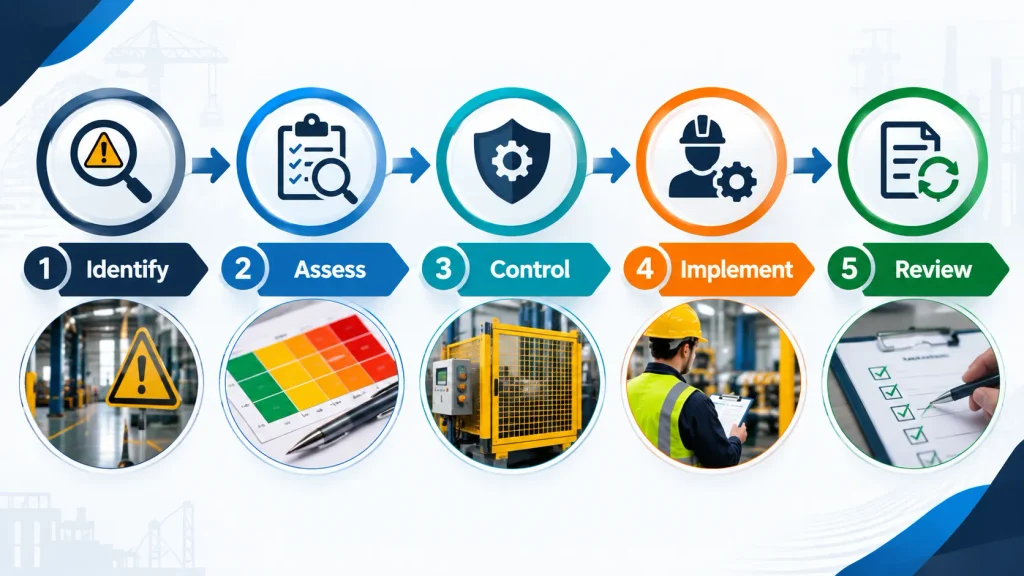
A completed risk assessment that is never communicated, implemented or reviewed does not by itself control the risk.
4. Selecting and Monitoring Risk Controls
After risks have been identified and assessed, appropriate controls need to be selected.
A Health and Safety Manager may work with engineers, supervisors, workers and other specialists to determine how risks can be eliminated or reduced.
Depending on the circumstances, controls may involve:
- Removing a hazardous activity
- Substituting a hazardous material or process
- Engineering controls
- Physical safeguards
- Administrative controls
- Safe working procedures
- Training and supervision
- Personal protective equipment
The most appropriate control depends on the hazard and the workplace.
A Health and Safety Manager also needs to consider whether controls are actually working.
For example, if a guarding system has been introduced to control access to dangerous machinery, simply installing the guard may not be enough. The manager may need to check whether it remains in place, whether workers understand the procedure and whether the control is being used correctly.
5. Developing Safe Systems of Work
Some workplace activities require clearly defined procedures explaining how work should be completed safely.
Health and Safety Managers may help develop or review safe systems of work for activities such as:
- Working at height
- Confined-space operations
- Electrical work
- Lifting operations
- Machinery operation
- Chemical handling
- Hot work
- Maintenance
- Excavation
- Construction activities
- Vehicle operations
A good procedure should reflect the actual workplace.
For example, a procedure written without considering the equipment, environment, workforce and sequence of the task may be difficult to implement effectively.
This is why Health and Safety Managers often work with operational teams and workers when reviewing procedures.
6. Conducting Workplace Inspections
Workplace inspections allow organisations to examine conditions and working practices and identify areas requiring attention.
A Health and Safety Manager may establish or participate in inspection programmes covering:
- Work areas
- Machinery
- Access routes
- Emergency equipment
- Personal protective equipment
- Storage arrangements
- Work practices
- Contractor activities
- Housekeeping
- Safety signage
- Environmental conditions
But an effective inspection should go beyond finding problems.
The inspection process should ideally connect:
Finding → Action → Responsibility → Deadline → Verification → Closure
For example, if an inspection identifies an unsafe access route, the manager may need to ensure that an appropriate person is assigned to address the issue and that the corrective action is subsequently checked.
This turns inspection into an active part of safety management.
7. Supporting Safety Audits
Health and Safety Managers may also participate in or coordinate audits.
An audit can provide a broader review of whether safety arrangements are being implemented as intended.
Depending on the organisation, an audit may examine:
- Policies
- Procedures
- Risk assessments
- Training records
- Inspection records
- Incident management
- Emergency arrangements
- Contractor controls
- Corrective actions
- Safety performance
- Management responsibilities
An inspection usually focuses more directly on workplace conditions or activities, whereas an audit can examine whether the management arrangements themselves are functioning effectively.
Both can provide valuable information for improvement.
8. Investigating Accidents, Incidents and Near Misses
Incident investigation can be an important part of the Health and Safety Manager’s responsibilities.
The objective should not simply be to establish who was involved.
A useful investigation seeks to understand:
- What happened?
- Where did it happen?
- What task was being performed?
- What hazards were present?
- What controls were supposed to be in place?
- Were those controls implemented?
- Were procedures understood?
- Did equipment or environmental conditions contribute?
- Were there organisational factors?
- What improvements are required?
Near misses can also provide valuable learning opportunities because they may reveal weaknesses before serious harm occurs.
Incident findings can then be used to improve risk assessments, procedures, training and controls.
ISO 45001 provides a recognised framework for occupational health and safety management and includes areas such as leadership, worker participation, hazard identification, risk assessment, emergency planning, incident investigation and continual improvement.
9. Managing Corrective Actions
Safety problems identified through inspections, audits, incidents or risk assessments often require corrective action.
A Health and Safety Manager may be responsible for coordinating or monitoring these actions.
A corrective-action process can involve:
- Recording the issue
- Determining what needs to be corrected
- Identifying the responsible person
- Establishing a target completion date
- Monitoring progress
- Confirming completion
- Checking effectiveness
This last stage is particularly important.
Closing an action because someone has stated that it has been completed is different from confirming that the underlying problem has actually been addressed.
For example, replacing damaged safety equipment may solve an immediate issue, but repeated equipment damage could indicate a wider problem requiring investigation.
10. Coordinating Health and Safety Training
Health and Safety Managers may help identify training requirements and coordinate appropriate learning activities.
Training needs can arise from:
- New employees
- New equipment
- New processes
- Changes in risk
- Incident findings
- Changes in procedures
- Competence gaps
- Contractor requirements
- Emergency arrangements
Potential topics can include:
- Workplace safety awareness
- Risk assessment
- Fire safety
- Emergency procedures
- Manual handling
- Machinery safety
- Chemical safety
- Personal protective equipment
- Working at height
- Permit-to-work systems
- Incident reporting
However, training should not automatically be used as the answer to every safety problem.
If a hazard can be better controlled through engineering or physical measures, training alone may not provide an adequate solution.
11. Monitoring Legal and Organisational Requirements
Health and Safety Managers may monitor requirements that apply to their organisation’s activities.
These can include:
- Applicable legislation
- Regulatory requirements
- Industry requirements
- Client requirements
- Contractual conditions
- Internal policies
- Organisational standards
The exact legal responsibilities depend on the jurisdiction, sector and type of work.
For this reason, Health and Safety Managers need to understand the requirements relevant to their particular workplace rather than relying on generic information.
In the UK, for example, HSE guidance emphasises effective planning, organisation, control, monitoring and review of preventive and protective measures.
International organisations may need to consider multiple regulatory environments and client expectations.
12. Supporting Emergency Preparedness
Emergency preparedness is another area where Health and Safety Managers can have an important role.
Potential emergencies may include:
- Fire
- Serious injury
- Chemical release
- Explosion
- Electrical incident
- Environmental emergency
- Severe weather
- Equipment failure
- Evacuation situations
The manager may help coordinate:
- Emergency procedures
- Evacuation arrangements
- Emergency contact systems
- First-aid provisions
- Emergency equipment
- Drills and exercises
- Communication arrangements
- Emergency responsibilities
Emergency arrangements should be practical and regularly reviewed rather than treated as documents that only need to exist for compliance purposes.
13. Monitoring Health and Safety Performance
Health and Safety Managers may monitor a range of indicators to understand how effectively the organisation is managing safety.
These may include:
- Incident trends
- Near-miss reports
- Inspection findings
- Audit findings
- Corrective-action completion
- Training completion
- Risk assessment reviews
- Safety observations
- Emergency drill results
- Worker feedback
Both reactive and proactive information can be useful.
For example, accident statistics tell an organisation about events that have already occurred. Inspection findings, safety observations and corrective-action data can provide information about potential weaknesses before they result in serious harm.
This allows managers to move towards more proactive safety management.
14. Preparing Health and Safety Reports
Health and Safety Managers may prepare reports for:
- Senior management
- Project managers
- Site management
- Clients
- Internal committees
- Contractors
- Other relevant stakeholders
Reports may cover:
- Significant risks
- Incidents
- Near misses
- Inspection results
- Audit findings
- Corrective actions
- Training
- Safety performance
- Emerging risks
- Improvement programmes
The ability to convert technical information into clear management information is therefore an important professional skill.
Senior leaders need to understand not only what happened but also:
- Why it matters
- What the organisation needs to do
- Who is responsible
- What resources may be required
- How progress will be measured
15. Promoting Worker Consultation and Participation
Health and safety should not be managed entirely from an office.
Workers can provide valuable information about:
- Actual working conditions
- Practical hazards
- Difficult procedures
- Equipment problems
- Unsafe practices
- Barriers to implementing controls
- Potential improvements
A Health and Safety Manager may therefore facilitate consultation through:
- Safety meetings
- Toolbox talks
- Worker feedback
- Safety committees
- Workplace discussions
- Consultation during risk assessments
- Incident reviews
The ILO identifies worker participation as an important element of an effective occupational safety and health management system.
16. Managing Contractor Safety
Many organisations rely on contractors for construction, maintenance, engineering, cleaning, transport or specialist services.
Health and Safety Managers may therefore help establish contractor safety arrangements.
These may involve:
- Contractor prequalification
- Competence checks
- Safety documentation
- Risk assessments
- Method statements
- Site induction
- Permit systems
- Monitoring
- Inspections
- Incident reporting
- Corrective actions
Contractor management becomes particularly important where several organisations operate within the same workplace.
17. Working With Other Departments
Health and Safety Managers rarely work in isolation.
They may interact with:
- Operations
- Engineering
- Maintenance
- Human Resources
- Procurement
- Quality
- Environmental teams
- Project management
- Site supervision
- Contractors
- Senior leadership
- Workers
This cross-functional nature of the role means that communication and collaboration are just as important as technical safety knowledge.
For example, an engineering team may be responsible for a machinery modification, while the Health and Safety Manager may provide input regarding risk controls and safe operation.
Similarly, Human Resources may manage employee processes while the safety function contributes information about training, workplace risks or occupational health considerations.
What Does a Health and Safety Manager Do on a Typical Day?
There is no universal daily schedule.
The activities of a Health and Safety Manager depend on the industry, workplace, project stage, organisational structure and current safety issues.
A typical day could include:
- Reviewing safety reports
- Checking outstanding corrective actions
- Attending management meetings
- Conducting a workplace inspection
- Reviewing a risk assessment
- Discussing a safety concern with a supervisor
- Meeting a contractor
- Investigating an incident
- Reviewing training requirements
- Analysing safety performance
- Preparing a management report
- Participating in an emergency exercise
- Consulting with workers
- Reviewing safety procedures
One day may be primarily office-based, while another may involve extensive site activities.
This variety is one reason the role requires both technical and interpersonal skills.
How Health and Safety Management Works in Practice
A useful way to understand the Health and Safety Manager’s role is through a continuous improvement cycle:
Plan
Identify significant risks, establish policies, determine objectives and plan appropriate controls.
Do
Implement procedures, controls, training, communication and operational arrangements.
Check
Monitor workplace conditions, inspect activities, review performance and investigate incidents.
Act
Address weaknesses, implement corrective actions and improve the management arrangements.
The HSE uses the Plan, Do, Check, Act model to describe a systematic approach to health and safety leadership and management.
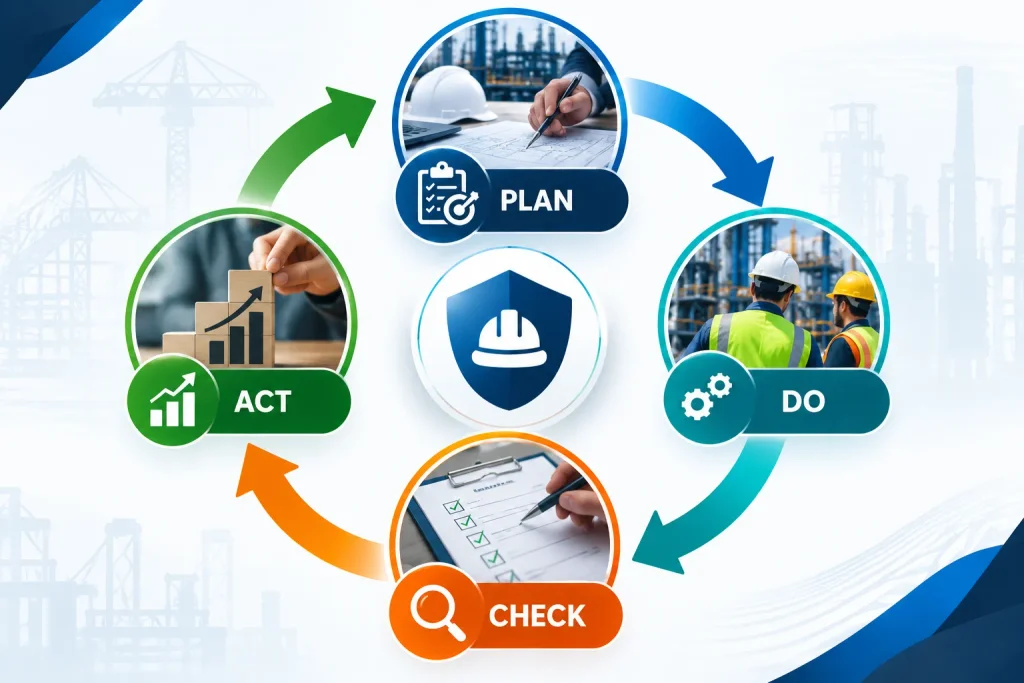
The important point is that the process is continuous.
When a new process is introduced, equipment changes, an incident occurs or working conditions change, the organisation may need to revisit its risk controls.
Essential Skills of a Health and Safety Manager
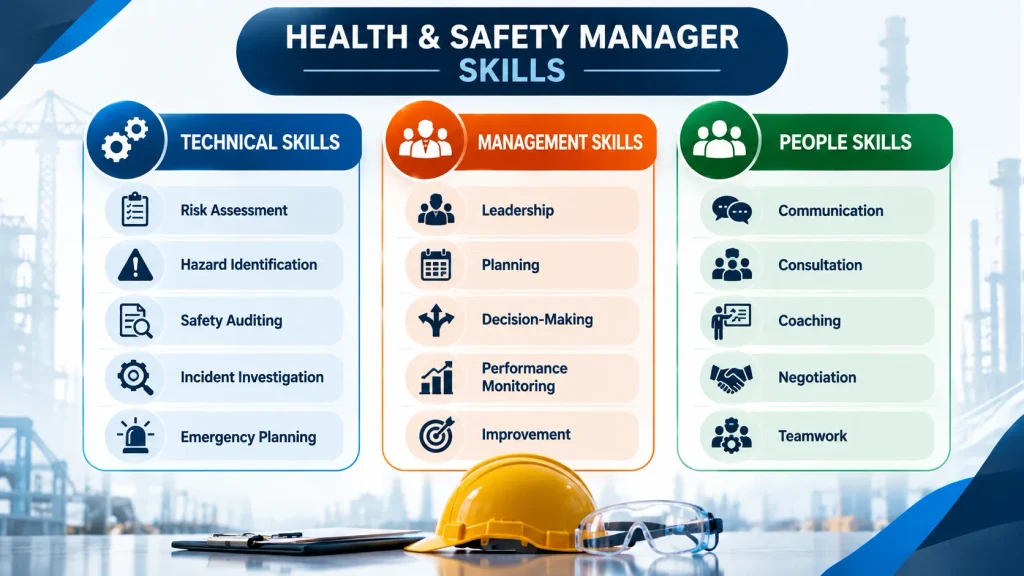
A Health and Safety Manager needs a combination of technical, managerial, analytical and communication skills.
Technical Health and Safety Skills
Important technical areas may include:
- Hazard identification
- Risk assessment
- Risk control
- Workplace inspections
- Safety auditing
- Incident investigation
- Emergency planning
- Safety procedures
- Safety management systems
- Workplace monitoring
- Regulatory awareness
- Performance measurement
Leadership and Management Skills
A Health and Safety Manager may also need to demonstrate:
- Leadership
- Planning
- Organisation
- Decision-making
- Prioritisation
- Project coordination
- Corrective-action management
- Resource planning
- Performance monitoring
- Strategic thinking
Health and safety leadership is not limited to the safety department. HSE guidance emphasises that effective health and safety leadership requires active direction from organisational leadership and integration with wider business management.
Communication Skills
Communication is essential because the role involves working with people at different levels.
Useful capabilities include:
- Written communication
- Verbal communication
- Report writing
- Presentation
- Consultation
- Negotiation
- Active listening
- Coaching
- Stakeholder communication
- Conflict management
A technically strong safety professional may still struggle if they cannot explain risks clearly or gain cooperation from people responsible for implementing controls.
Analytical and Problem-Solving Skills
Health and Safety Managers regularly need to interpret information and determine what it means.
For example, repeated inspection findings in different departments may indicate a common management-system weakness.
Similarly, an increase in near-miss reports may require further investigation rather than automatically being interpreted as deteriorating performance.
Analytical thinking helps the manager move from individual observations to broader patterns and improvement opportunities.
Health and Safety Manager vs Health and Safety Adviser vs Health and Safety Officer
These job titles are not used identically by every organisation, so responsibilities can overlap.
However, a general comparison can be useful:
| Role | Typical focus |
|---|---|
| Health and Safety Manager | Management, coordination, safety programmes, performance and organisational improvement |
| Health and Safety Adviser | Specialist advice, risk assessment, inspection, guidance and recommendations |
| Health and Safety Officer | Practical workplace monitoring, inspections, reporting and implementation |
| HSE Manager | Often combines health, safety and environmental management responsibilities, depending on the organisation |
The actual responsibilities should always be checked against the employer’s job description and organisational structure.
What Qualifications Can Support a Health and Safety Manager Career?
There is no single qualification that defines every Health and Safety Manager role worldwide.
The appropriate professional development route depends on:
- Existing experience
- Current responsibilities
- Industry
- Employer requirements
- Career objectives
- Existing qualifications
- Level of management responsibility
- Professional development needs
Qualifications can help Learners develop structured knowledge across areas such as:
- Occupational health and safety management
- Risk management
- Safety leadership
- Workplace safety practice
- HSE engineering
- Environmental management
- Safety systems
- Incident investigation
- Safety performance
For professionals interested in occupational health and safety management, Communique-Aide provides a range of professional qualifications through its Professional Trainings & Certifications page.
Relevant options on the qualification portfolio include occupational health and safety management and practice-focused qualifications at different levels.
The most suitable option should be considered in relation to the Learner’s existing experience, current role and professional objectives.
Health and Safety Manager Roles in Pakistan
Health and safety management is relevant across many sectors in Pakistan where workplace activities involve operational, construction, engineering or industrial risks.
Potential sectors include:
- Construction
- Manufacturing
- Engineering
- Oil and gas
- Energy
- Infrastructure
- Logistics
- Warehousing
- Industrial facilities
- Facilities management
- Large commercial organisations
The responsibilities of a Health and Safety Manager can differ between organisations.
For example, a manager working on a construction project may spend substantial time on site inspections, contractor coordination, risk assessments and permit-related activities, while a manager in a manufacturing organisation may focus more heavily on machinery safety, process risks, maintenance activities and production-related controls.
Professionals working in Pakistan can therefore benefit from combining general occupational health and safety knowledge with sector-specific understanding.
Health and Safety Management in International Workplaces
Health and Safety Managers working across international projects may need to understand different regulatory requirements, client expectations and organisational standards.
International management frameworks can provide useful structures for organising safety activities, but organisations must still consider the laws and requirements applicable to the jurisdiction where work is being performed.
ISO 45001 is one internationally recognised occupational health and safety management system standard. It provides a framework covering areas such as policy, planning, implementation, auditing, review, leadership, worker participation, risk management and continual improvement.
Understanding management-system principles can therefore be useful for professionals working with organisations that use formal OH&S management systems.
Why Is a Health and Safety Manager Important?
The importance of the Health and Safety Manager comes from the need to manage workplace risks systematically.
The role can help an organisation:
- Identify hazards
- Understand workplace risks
- Establish appropriate controls
- Monitor safety performance
- Learn from incidents
- Improve procedures
- Support worker consultation
- Strengthen emergency preparedness
- Coordinate corrective actions
- Improve safety communication
- Support continual improvement
However, workplace safety should not depend on one person.
Senior leaders, managers, supervisors, workers, contractors and other relevant personnel all have roles in maintaining safe working conditions.
The Health and Safety Manager helps coordinate and strengthen the system, but effective safety management requires organisational participation.
What Makes an Effective Health and Safety Manager?
An effective Health and Safety Manager needs to balance technical knowledge with practical judgement.
They should be able to move between different levels of work:
Strategic level
Understanding organisational risks, objectives, policies and safety performance.
Management level
Planning programmes, coordinating resources, monitoring performance and reporting to leadership.
Operational level
Visiting workplaces, identifying hazards, reviewing controls and engaging with workers.
Improvement level
Learning from incidents, analysing trends and implementing corrective actions.
This combination makes the role broader than simply enforcing workplace rules.
A Health and Safety Manager needs to understand how people, processes, equipment, management systems and organisational decisions interact to influence workplace risk.
Conclusion
A Health and Safety Manager does far more than inspect workplaces or enforce safety procedures.
The role brings together hazard identification, risk assessment, risk control, workplace inspections, incident investigation, training, emergency preparedness, performance monitoring, corrective actions, worker consultation and safety leadership.
The role can be understood as a continuous process:
Identify → Assess → Control → Communicate → Monitor → Review → Improve
The most effective Health and Safety Managers are able to connect technical safety knowledge with management, communication, leadership and practical workplace experience.
For professionals looking to develop their knowledge in occupational health and safety management, structured professional qualifications can provide an opportunity to build knowledge relevant to workplace safety, risk management and management responsibilities.