
Occupational Health and Safety: Complete Workplace Safety Guide 2026
Occupational health and safety is a fundamental part of responsible working environments. It is not limited to preventing accidents or ensuring that workers wear personal protective equipment. Modern occupational health and safety covers the identification of hazards, assessment and control of risks, protection of physical and psychological health, emergency preparedness, worker participation, safety leadership, monitoring and continual improvement.
The International Labour Organization (ILO) recognises a safe and healthy working environment as a fundamental principle and right at work. Its current occupational safety and health framework also addresses established hazards alongside emerging issues such as climate change, new technologies, artificial intelligence, digitalisation and changing forms of work.
For organisations, effective occupational health and safety means creating systems that help people perform their work without unnecessary exposure to hazards. For professionals, it requires the ability to recognise hazards, evaluate risks, recommend suitable controls, communicate effectively and contribute to continuous improvement.
This complete guide explains the principles of occupational health and safety, common workplace hazards, risk assessment, the hierarchy of controls, safety management systems, inspections, audits, incident investigation, safety culture, leadership, emerging risks and professional roles.
What Is Occupational Health and Safety?
Occupational health and safety, commonly abbreviated as OHS or OSH, is the multidisciplinary approach to protecting people from work-related injury, illness and other forms of harm.
It involves identifying hazards associated with work activities, understanding the risks they create and implementing suitable measures to eliminate or control those risks.
A modern OHS approach considers much more than immediate physical accidents. It can include:
- workplace injuries
- occupational diseases
- chemical exposure
- biological hazards
- ergonomic problems
- excessive noise and vibration
- electrical hazards
- fire and explosion risks
- work at height
- machinery-related hazards
- psychosocial risks
- fatigue and workload
- extreme temperatures
- workplace emergencies
- changing technological and organisational risks
The purpose is therefore not simply to react after an accident. Effective OHS aims to anticipate hazards and prevent harm wherever reasonably practicable.
Occupational Health
Occupational health focuses on protecting and promoting people’s health in relation to their work.
Depending on the workplace, this may involve consideration of:
- exposure to hazardous substances
- occupational diseases
- noise
- vibration
- radiation
- dust and fumes
- manual handling
- ergonomics
- workplace temperature
- biological agents
- fatigue
- work-related stress
- other physical and psychosocial factors
Occupational health can involve prevention, health surveillance, workplace assessments and professional advice, depending on the risks and regulatory requirements involved.
Occupational Safety
Occupational safety is more closely associated with preventing injuries, accidents and dangerous events arising from work activities.
Examples include controlling:
- machinery hazards
- electrical risks
- falls from height
- vehicle movements
- lifting operations
- excavation
- fire
- explosions
- slips and trips
- unsafe equipment
- confined-space work
In practice, occupational health and occupational safety overlap significantly. A poorly controlled chemical exposure, for example, can create both an immediate safety hazard and a longer-term occupational health risk.
Occupational Health and Safety vs Workplace Safety
The terms are often used interchangeably, but workplace safety can sometimes be used more narrowly to describe immediate injury-prevention activities.
Occupational health and safety has a broader scope.
| Area | Main focus |
|---|---|
| Workplace safety | Preventing accidents and immediate physical harm |
| Occupational health | Preventing work-related illness and protecting health |
| Occupational health and safety | Integrating health, safety, risk management and prevention |
| Safety management | Organising people, processes and controls to manage safety |
| Occupational risk management | Identifying, assessing and controlling workplace risks |
OHS, OSH and WHS: What Do These Terms Mean?
You may encounter several abbreviations when researching workplace safety.
OHS generally means Occupational Health and Safety.
OSH generally means Occupational Safety and Health.
WHS generally means Work Health and Safety and is commonly used in some jurisdictions.
The terminology varies between countries and organisations. The underlying objective remains broadly connected: protecting people from work-related hazards and supporting safe and healthy working environments.
Why Is Occupational Health and Safety Important?
Occupational health and safety is important because workplace hazards can affect people’s health, safety, livelihoods and quality of life.
The scale of the issue is substantial. The ILO currently reports an estimated 2.93 million deaths each year resulting from work-related factors and approximately 395 million non-fatal work injuries annually. It also reports that around 2.41 billion workers are exposed to excessive heat each year.
These figures demonstrate why OHS needs to be treated as an organised prevention activity rather than simply a collection of workplace rules.
Protecting Workers
The primary purpose of OHS is to protect people from avoidable workplace harm.
This includes preventing:
- injuries
- occupational illnesses
- hazardous exposures
- unsafe working conditions
- foreseeable emergencies
- long-term health consequences
Identifying Workplace Risks
A structured OHS process helps organisations recognise hazards before they result in harm.
For example, a workplace inspection might identify:
- damaged electrical equipment
- inadequate machine guarding
- blocked emergency exits
- poor housekeeping
- unsafe storage
- excessive noise
- inadequate ventilation
Identifying these issues provides an opportunity to take corrective action.
Supporting Legal and Regulatory Responsibilities
OHS requirements differ between countries, industries and activities.
Organisations therefore need to understand the laws, regulations, codes, permits, standards and other requirements applicable to their operations.
International guidance does not replace national legislation.
Supporting Organisational Resilience
Effective safety management can also help organisations prepare for disruption by identifying operational vulnerabilities, establishing emergency procedures and improving response arrangements.
However, the specific business benefits of OHS vary according to the organisation, industry and quality of implementation.
What Does Occupational Health and Safety Cover?
Occupational health and safety is multidisciplinary.
It can involve elements of:
- engineering
- occupational medicine
- industrial hygiene
- ergonomics
- psychology
- environmental management
- emergency management
- risk management
- organisational leadership
- workplace communication
- legal and regulatory compliance
The current OSH framework includes hazard and risk areas such as biological hazards, chemical hazards, ergonomics, psychosocial factors, physical hazards and radiation, alongside climate change and technological change.
A useful way to understand OHS is:
People
   ↓
Work activities
   ↓
Hazards
   ↓
Risk
   ↓
Controls
   ↓
Monitoring
   ↓
Learning
   ↓
Continuous improvement
OHS is therefore both a technical and organisational discipline.
Types of Workplace Hazards
A hazard is a source, situation, activity or behaviour with the potential to cause harm.
A hazard does not necessarily mean that an accident or illness will occur. The level of risk depends on factors such as exposure, likelihood, severity and the effectiveness of existing controls.
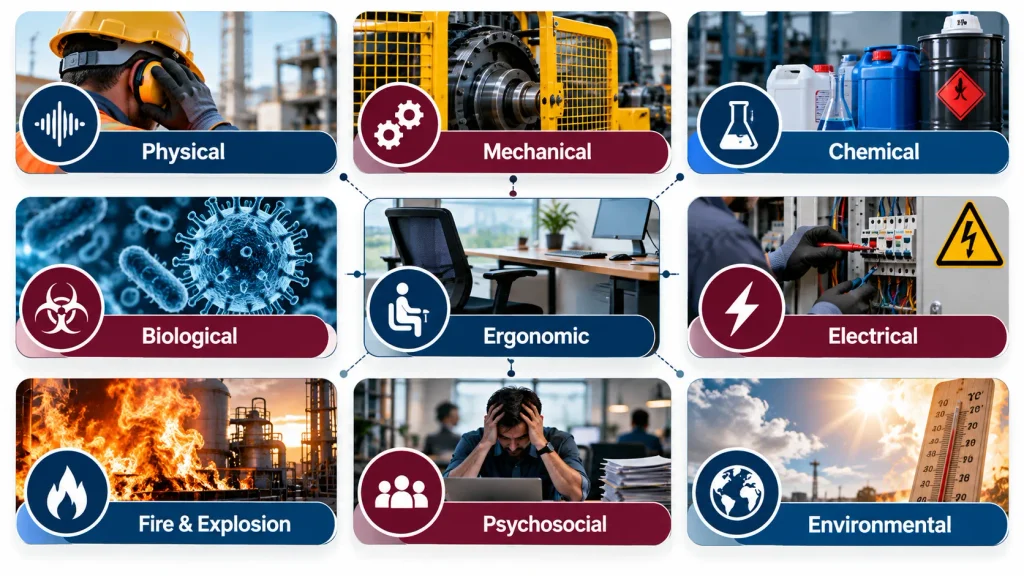
Common categories including physical, chemical, biological, ergonomic and psychosocial hazards.
Physical Hazards
Physical hazards can arise from the physical conditions of the workplace.
Examples include:
- excessive noise
- vibration
- extreme temperatures
- radiation
- poor lighting
- slippery surfaces
- falling objects
- workplace traffic
- pressure systems
For example, prolonged exposure to excessive workplace noise can create occupational health concerns, while inadequate lighting can contribute to errors, trips or other incidents.
Mechanical Hazards
Mechanical hazards are associated with machinery, moving components, tools and equipment.
Examples include:
- rotating machinery
- cutting equipment
- crushing points
- entanglement
- shearing
- moving vehicles
- unguarded machinery
Controls may include machine guarding, isolation, safe operating procedures, maintenance and competence requirements.
Chemical Hazards
Chemical hazards can arise from:
- toxic substances
- corrosive chemicals
- flammable substances
- solvents
- fumes
- vapours
- gases
- dusts
The appropriate controls depend on the substance, exposure route, quantity, task and workplace conditions.
Biological Hazards
Biological hazards can include:
- bacteria
- viruses
- fungi
- mould
- parasites
- contaminated biological materials
Healthcare, laboratories, agriculture, food processing and waste management may involve particular biological risks, although biological hazards can occur in many other settings.
Ergonomic Hazards
Ergonomic hazards arise when work, equipment or workplace design does not adequately fit the capabilities and needs of people performing the task.
Examples include:
- repetitive movements
- awkward postures
- poorly designed workstations
- prolonged static positions
- excessive manual handling
- unsuitable tool design
Ergonomic controls may involve redesigning the task, modifying equipment, changing workstation arrangements or adjusting work methods.
Electrical Hazards
Electrical hazards can include:
- exposed conductors
- damaged cables
- faulty equipment
- inadequate isolation
- overloaded systems
- unsuitable electrical installations
- contact with live parts
Electrical safety requires appropriate engineering controls, competent work practices, inspection, maintenance and compliance with applicable requirements.
Fire and Explosion Hazards
Fire and explosion risks may arise from combinations of:
- ignition sources
- combustible materials
- flammable substances
- oxygen
- dust
- gases
- inadequate storage
- unsuitable equipment
Effective fire safety requires appropriate prevention, detection, protection, emergency arrangements and maintenance.
Psychosocial Hazards
Modern OHS also recognises risks associated with how work is organised and experienced.
Potential psychosocial factors include:
- excessive workload
- insufficient control over work
- violence
- harassment
- bullying
- poor organisational support
- long or unpredictable working hours
- work-related stress
- isolation
These risks require organisational as well as individual-level consideration.
Environmental and Climate-Related Hazards
Climate-related workplace risks are increasingly relevant.
Examples include:
- excessive heat
- extreme weather
- flooding
- changing environmental conditions
- poor air quality
Climate change is an important area of occupational safety and health and reports significant global worker exposure to excessive heat.
Hazard Identification in the Workplace
Hazard identification is the process of recognising sources of potential harm before they result in an unwanted event.
It should not rely on a single observation.
Useful sources of information can include:
- workplace inspections
- worker feedback
- incident reports
- near-miss reports
- equipment information
- maintenance records
- health assessments
- exposure monitoring
- previous risk assessments
- manufacturer information
- task observations
- changes in work processes
A Practical Hazard Identification Process
A simple process can be:
- Identify the work activity.
- Observe how the task is actually performed.
- Identify potential sources of harm.
- Identify who may be exposed.
- Consider existing controls.
- Record significant hazards.
- Determine whether additional assessment or controls are required.
For example:
| Activity | Hazard | Potential harm | Possible controls |
|---|---|---|---|
| Cutting material | Moving blade | Cuts or amputation | Guarding, safe procedure, competent operation |
| Manual handling | Heavy load | Musculoskeletal injury | Mechanical aid, task redesign, training |
| Chemical cleaning | Hazardous substance | Exposure or burns | Substitution, ventilation, safe handling, PPE |
| Work at height | Unprotected edge | Fall | Elimination, edge protection, suitable access system |
| Electrical maintenance | Live electrical parts | Electric shock | Isolation, verification, competent personnel |
The exact controls must always be determined from the actual task and applicable requirements.
Occupational Health and Safety Risk Assessment
Risk assessment is a central part of occupational health and safety management.
It involves considering hazards, exposure, likelihood, consequences and existing controls to determine whether further action is required.
A practical risk assessment process can include six stages.
Step 1: Identify the Hazards
Consider:
- equipment
- materials
- substances
- work activities
- workplace conditions
- people
- environmental conditions
- organisational factors
Step 2: Identify Who May Be Harmed
Consider workers as well as other people who could be affected.
Depending on the workplace, this might include:
- employees
- contractors
- visitors
- members of the public
- delivery personnel
- maintenance personnel
Particular attention may be required for people who are inexperienced, vulnerable to particular exposures or performing unfamiliar tasks.
Step 3: Evaluate the Risk
Risk evaluation may consider:
- likelihood
- severity
- frequency of exposure
- number of people exposed
- effectiveness of existing controls
Organisations may use risk matrices or other structured methods, but the method should be suitable for the nature and complexity of the workplace.
Step 4: Select Controls
Controls should address the source of the risk wherever practicable.
This is where the hierarchy of controls becomes important.
Step 5: Implement Controls
Controls need to be:
- assigned
- communicated
- implemented
- maintained
- monitored
A control that exists only on paper does not provide effective protection.
Step 6: Review the Assessment
Risk assessments should be reviewed when:
- work processes change
- equipment changes
- new substances are introduced
- an incident occurs
- a significant hazard is identified
- controls prove ineffective
- new information becomes available
A risk assessment should therefore be treated as a working management tool rather than a document completed once and forgotten.
The Hierarchy of Controls
The hierarchy of controls provides a way to prioritise risk-control measures.
The five commonly recognised levels are:
- Elimination
- Substitution
- Engineering controls
- Administrative controls
- Personal protective equipment
Elimination
Elimination means removing the hazard entirely.
Example:
If a hazardous manual process can be removed through redesign or automation, the associated exposure may be eliminated.
Substitution
Substitution means replacing something hazardous with a safer alternative.
Example:
Replacing a hazardous chemical with a less hazardous substance where technically and operationally suitable.
Engineering Controls
Engineering controls isolate people from hazards or reduce exposure through physical design.
Examples include:
- machine guarding
- local exhaust ventilation
- barriers
- interlocks
- isolation systems
- acoustic enclosures
Administrative Controls
Administrative controls involve changes to how work is organised or performed.
Examples include:
- procedures
- training
- supervision
- scheduling
- warning systems
- permits
- inspection programmes
Personal Protective Equipment
PPE provides protection to the wearer when exposure cannot be adequately controlled through other measures.
Examples include:
- safety helmets
- protective footwear
- eye protection
- hearing protection
- gloves
- respiratory protective equipment
- protective clothing
PPE is important, but it should not automatically be treated as the first or only control.
Occupational Health and Safety Management Systems
An OHS management system provides a structured framework for managing workplace safety and health.
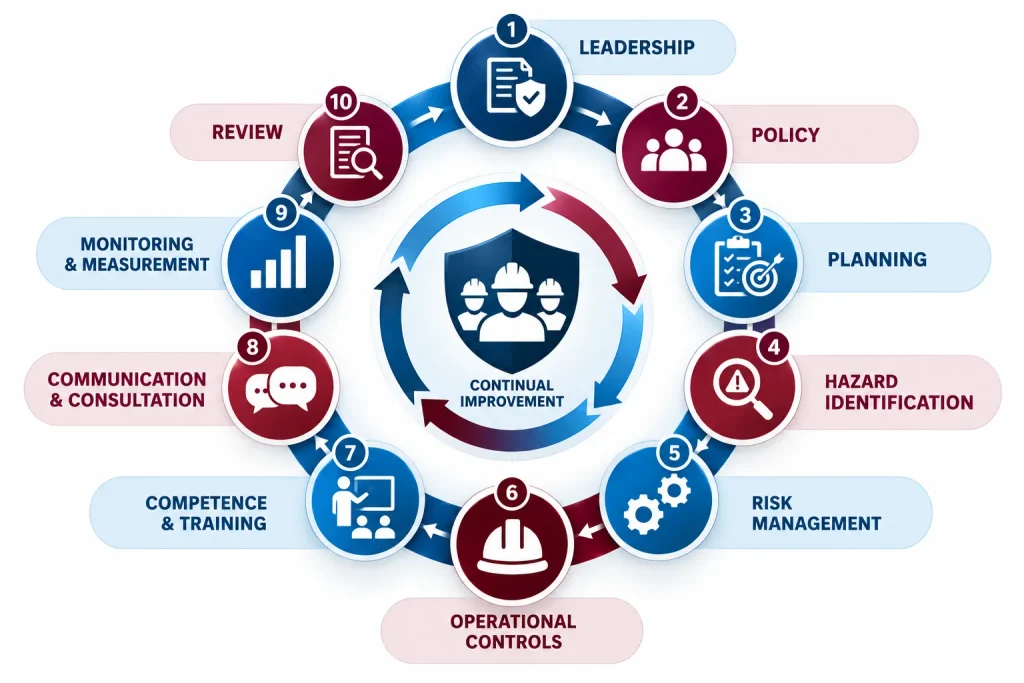
It helps an organisation move from isolated safety activities towards an organised and continually improving system.
Core elements can include:
- leadership
- policy
- planning
- hazard identification
- risk assessment
- operational controls
- competence
- communication
- worker consultation
- monitoring
- incident management
- auditing
- management review
- continual improvement
OHS Policy
An OHS policy establishes the organisation’s commitment and provides direction for its safety management activities.
A useful policy should be appropriate to the organisation’s:
- activities
- size
- risks
- workforce
- operational environment
Leadership and Responsibility
Safety responsibilities should be understood throughout the organisation.
Senior management has an important role in:
- establishing direction
- providing resources
- setting expectations
- reviewing performance
- supporting improvement
Supervisors and managers also influence how safety requirements are applied during everyday work.
Competence and Training
People need appropriate knowledge and competence for the tasks they perform.
Training may address:
- workplace hazards
- safe operating procedures
- emergency response
- equipment
- hazardous substances
- PPE
- reporting arrangements
- specific job requirements
Communication and Consultation
OHS information needs to move in both directions.
Management should communicate requirements, but workers should also be able to report:
- hazards
- near misses
- concerns
- equipment problems
- unsafe practices
- improvement suggestions
Worker participation is an important component of effective prevention. ISO’s current guidance specifically encourages organisations to involve workers in OHS decisions and reporting.
Workplace Safety Inspections
A workplace safety inspection is a structured examination of workplace conditions, activities or equipment to identify hazards and verify whether controls are being applied.
Inspections may focus on:
- housekeeping
- machinery
- electrical equipment
- access routes
- emergency equipment
- PPE
- storage
- work at height
- chemical handling
- vehicles
- construction activities
A Practical Inspection Process
Before the inspection
Review:
- previous inspection findings
- incidents
- outstanding corrective actions
- relevant risk assessments
- changes to the workplace
During the inspection
Observe:
- workplace conditions
- actual work practices
- equipment
- controls
- worker behaviour
- housekeeping
After the inspection
Record:
- findings
- responsible persons
- corrective actions
- target dates
- follow-up requirements
An inspection is most useful when findings lead to appropriate action and verification.
Occupational Health and Safety Audits
An OHS audit is different from a routine workplace inspection.
An audit generally examines whether a defined system, process or set of requirements is being implemented and maintained.
A simple comparison is:
| Activity | Primary purpose |
|---|---|
| Workplace inspection | Identify hazards and unsafe conditions or practices |
| OHS audit | Examine whether the management system or defined requirements are being implemented |
| Incident investigation | Understand what happened and identify contributing factors |
For example, an inspection might discover that emergency exits are blocked.
An audit might examine whether the organisation has an effective process for emergency-route inspections, responsibilities, monitoring and corrective action.
An incident investigation would be conducted after an event to understand what happened and why.
Workplace Incidents and Near Misses
An incident can provide important information about weaknesses in workplace controls.
Depending on the circumstances, incident management may involve:
- Immediate response
- Making the area safe
- Providing assistance
- Preserving relevant evidence
- Reporting the event
- Gathering information
- Identifying contributing factors
- Determining corrective actions
- Implementing improvements
- Reviewing whether the actions worked
Why Near Misses Matter
A near miss is an event that could have resulted in harm but did not.
Near misses can provide useful prevention information because they may reveal weaknesses before a more serious outcome occurs.
For example:
A falling object that narrowly misses a worker may indicate a problem with storage, securing materials, access arrangements or exclusion controls.
The correct response is not simply to record the event. The organisation should consider why the situation occurred and whether similar conditions exist elsewhere.
Emergency Preparedness and Response
Some hazards cannot be completely eliminated, so organisations need appropriate emergency arrangements.
Depending on the workplace, emergency planning may cover:
- fire
- medical emergencies
- chemical releases
- explosions
- structural incidents
- severe weather
- power failures
- security incidents
- environmental emergencies
An emergency plan should establish appropriate:
- responsibilities
- communication arrangements
- evacuation procedures
- emergency equipment
- assembly arrangements
- contact information
- response procedures
- training
- drills
Emergency plans should be reviewed when workplace conditions or risks change.
Building a Positive Safety Culture
Safety culture describes how an organisation approaches safety through its behaviours, attitudes, leadership, communication and everyday practices.
A positive safety culture cannot be created simply by publishing a policy.
It develops through consistent actions.
Characteristics of a Strong Safety Culture
These can include:
- visible leadership commitment
- open reporting
- worker participation
- appropriate training
- effective communication
- learning from incidents
- consistent application of controls
- accountability
- attention to both health and safety
- continuous improvement
Worker Participation
Workers often have direct knowledge of how tasks are actually performed.
They may identify:
- practical difficulties with procedures
- equipment problems
- hazards not obvious during formal assessments
- ineffective controls
- emerging risks
For this reason, worker consultation should be integrated into appropriate OHS processes.
ISO similarly emphasises worker involvement as part of effective OHS practice.
Safety Leadership and Safety Management
Safety leadership and safety management are related but not identical.
Safety management concerns the systems and processes used to manage workplace risks.
Safety leadership concerns how people influence safety through:
- decisions
- communication
- behaviour
- priorities
- example
- accountability
A manager may have an excellent written safety procedure, but leadership is also demonstrated by what happens when operational pressure, deadlines or unexpected problems arise.
Effective safety leadership can involve:
- listening to concerns
- allocating appropriate resources
- responding to reported hazards
- reinforcing safe practices
- reviewing performance
- learning from incidents
- involving workers in decisions
Occupational Health and Safety Across Different Industries
OHS principles apply across many sectors, but the hazards and control measures vary considerably.
Construction
Construction can involve:
- work at height
- excavation
- lifting operations
- temporary works
- machinery
- electrical systems
- traffic
- dust
- noise
- changing work environments
In Pakistan, construction safety has received significant recent policy attention. In April 2026, the Government of Pakistan approved a national Occupational Safety and Health Code of Practice for the construction sector, with the ILO describing it as establishing legally binding standards for construction safety and health.
Oil and Gas
Potential risks include:
- hydrocarbons
- fire and explosion
- process safety
- confined spaces
- pressure systems
- hazardous substances
- lifting operations
- work at height
- maintenance activities
Manufacturing
Manufacturing environments may involve:
- machinery
- electrical systems
- chemicals
- noise
- material handling
- automation
- production lines
- maintenance
Engineering
Engineering workplaces can combine mechanical, electrical, civil, process and environmental hazards.
Risk management therefore needs to reflect the actual engineering activities being undertaken.
Healthcare
Healthcare environments can involve:
- biological hazards
- chemicals
- sharps
- radiation
- manual handling
- psychosocial risks
- infectious disease exposure
Logistics and Warehousing
Common risks can include:
- vehicle movements
- forklifts
- manual handling
- storage systems
- falling objects
- loading and unloading
- pedestrian interaction
Energy
Energy-sector risks vary significantly according to the activity but can involve:
- electrical hazards
- high-energy systems
- work at height
- fire
- hazardous substances
- machinery
- environmental conditions
Offices and Commercial Workplaces
Office environments may have lower levels of some industrial hazards but still require attention to:
- ergonomics
- slips and trips
- electrical equipment
- fire
- emergency evacuation
- indoor environmental conditions
- psychosocial risks
- work-related stress
Emerging Occupational Health and Safety Risks
The nature of work is changing, and OHS management must respond accordingly.
Climate and Heat
Heat exposure is an increasingly important occupational health concern.
This can be particularly relevant to:
- construction
- agriculture
- manufacturing
- logistics
- outdoor maintenance
- transport
- energy
- emergency services
Workplace controls may include suitable work scheduling, hydration arrangements, shaded or cooled rest areas, monitoring and appropriate procedures, depending on the circumstances and applicable requirements.
Artificial Intelligence and Automation
Automation and AI can change how work is organised and performed.
Potential OHS considerations can include:
- interaction with automated machinery
- new maintenance tasks
- changes in job design
- human-machine interaction
- new competence requirements
- psychosocial impacts
- monitoring and decision-making processes
Technology can create new risks, but it can also support hazard monitoring and prevention.
Digitalisation
Digital systems are increasingly used for:
- inspections
- reporting
- training
- monitoring
- incident management
- data analysis
Digital tools should support sound safety processes rather than become a substitute for professional judgement or worker engagement.
Remote and Hybrid Work
Remote work can create different OHS considerations, including:
- workstation ergonomics
- work environment
- isolation
- working hours
- psychosocial factors
- communication
- emergency arrangements
The appropriate approach depends on the work and the organisation’s responsibilities.
Psychosocial Risks
Work-related psychosocial risks are now a significant part of modern OHS discussions.
Organisations may need to consider:
- workload
- working hours
- organisational support
- workplace relationships
- violence and harassment
- job control
- work-life boundaries
These risks should be managed through appropriate organisational and preventive measures.
Occupational Health and Safety in Different Regulatory Contexts
OHS principles are international, but legal requirements are not identical everywhere.
A multinational organisation may therefore need to manage:
International frameworks + national legislation + industry requirements + organisational standards.
Pakistan
Pakistan’s OHS framework involves national and provincial dimensions, with labour administration and workplace requirements operating through different legal and institutional arrangements.
The ILO’s Pakistan material notes that OSH has historically been addressed through different laws applying across industrial and commercial sectors, with provincial labour inspectorates having regulatory responsibilities within their jurisdictions.
The ILO’s current country information lists Pakistan’s national OSH profile and provides information on its ratification status for the ILO’s fundamental OSH conventions.
The regulatory position should always be checked against the legislation and requirements applicable to the specific province, industry and activity.
United Kingdom
The UK has a well-developed statutory health and safety framework. For example, the Health and Safety at Work etc. Act 1974 establishes broad duties concerning workplace health, safety and welfare, while additional regulations address particular activities and hazards.
UK requirements should not, however, be assumed to apply automatically to workplaces in other countries.
International Workplaces
Organisations operating internationally often need to understand both:
- local legal requirements
- international management frameworks
The ILO provides international standards and guidance, while ISO 45001 provides a framework for occupational health and safety management systems.
The correct approach is therefore to use international frameworks alongside the applicable national requirements.
Role of an Occupational Health and Safety Professional
An occupational health and safety professional may contribute to many areas of workplace risk management.
Responsibilities vary according to job title, industry, organisation and jurisdiction.
Typical activities can include:
- workplace inspections
- hazard identification
- risk assessments
- safety procedures
- incident investigation
- safety reporting
- training coordination
- emergency planning
- corrective-action monitoring
- compliance support
- contractor safety
- safety performance monitoring
- management reporting
- worker consultation
Some professionals specialise in particular fields such as:
- construction safety
- process safety
- occupational hygiene
- environmental management
- fire safety
- industrial safety
- electrical safety
- ergonomics
- occupational health
Skills Needed in Occupational Health and Safety
Successful OHS work requires a combination of technical, analytical and interpersonal skills.
| Skill | Workplace application |
|---|---|
| Hazard identification | Recognising potential sources of harm |
| Risk assessment | Evaluating risks and selecting controls |
| Inspection | Identifying unsafe conditions and practices |
| Communication | Explaining safety information clearly |
| Incident investigation | Analysing events and contributing factors |
| Documentation | Maintaining accurate safety records |
| Problem-solving | Developing practical risk controls |
| Emergency planning | Preparing for foreseeable emergencies |
| Data analysis | Monitoring safety performance |
| Leadership | Supporting a positive safety culture |
| Training | Developing workplace competence |
| Consultation | Working with workers and management |
Technical knowledge is important, but OHS professionals also need to communicate effectively with people who have different responsibilities, experience and technical backgrounds.
Occupational Health and Safety Qualifications
Professional development in OHS can cover a wide range of subject areas.
Depending on a person’s role and career objectives, relevant study areas may include:
- occupational health and safety
- safety management
- occupational health
- HSE engineering
- risk management
- environmental management
- safety leadership
- auditing
- emergency management
A suitable qualification should be evaluated according to factors such as:
- awarding organisation
- qualification level
- curriculum
- learning outcomes
- assessment method
- credit value
- delivery format
- entry requirements
- relevance to the intended professional role
For learners exploring professional qualifications, Communique Aide provides programmes across occupational health and safety, HSE engineering, safety management and related fields.
Relevant programmes can be explored through the Communique Aide Professional Trainings & Certifications section.
Occupational Health and Safety Management: A Practical Framework
A useful way to understand the complete OHS process is to view it as a continuous cycle.
1. PLAN
      ↓
2. IDENTIFY HAZARDS
      ↓
3. ASSESS RISKS
      ↓
4. SELECT CONTROLS
      ↓
5. IMPLEMENT
      ↓
6. TRAIN & COMMUNICATE
      ↓
7. INSPECT & MONITOR
      ↓
8. INVESTIGATE & LEARN
      ↓
9. REVIEW
      ↓
10. IMPROVE
      ↓
   REPEAT
This approach helps organisations move away from purely reactive safety management.
Instead of waiting for an accident before taking action, organisations can use inspections, risk assessments, worker feedback, monitoring and near-miss information to identify opportunities for prevention.
OHS Inspection, Risk Assessment and Audit: How They Work Together
These activities should not be viewed as isolated processes.
For example:
A workplace inspection identifies a damaged machine guard.
↓
The hazard is recorded.
↓
A risk assessment evaluates the potential consequences and exposure.
↓
Appropriate controls are selected.
↓
The organisation implements the corrective action.
↓
A subsequent inspection verifies the condition.
↓
An audit may later examine whether the organisation’s machinery-safety management process is working effectively.
Inspection vs Audit vs Incident Investigation
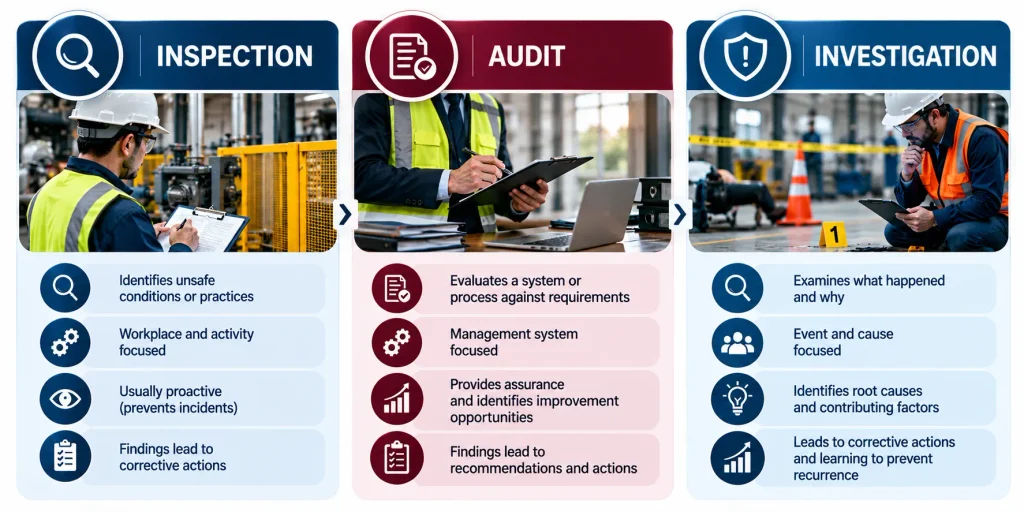
This illustrates how different OHS activities connect to create a functioning management system.
Measuring Occupational Health and Safety Performance
Organisations need appropriate information to understand whether their safety arrangements are working.
Possible indicators include:
Leading indicators
These focus on preventive activity.
Examples:
- completed safety inspections
- training completion
- corrective-action closure
- safety observations
- risk assessments reviewed
- emergency drills
- worker consultation activities
Lagging indicators
These focus on events that have already occurred.
Examples:
- injuries
- incidents
- occupational illnesses
- lost-time cases
- property damage
- reportable events
A mature approach generally avoids relying on one measurement alone.
The organisation should consider whether its selected indicators actually help decision-makers understand risk and improve controls.
How Organisations Can Improve Occupational Health and Safety
Continuous improvement does not necessarily mean introducing a complicated new system.
Practical improvement can begin by asking:
- What hazards exist?
- Which risks are most significant?
- Which controls currently exist?
- Are those controls actually being used?
- Are they effective?
- What are workers reporting?
- What do inspections show?
- What do incidents and near misses tell us?
- What changes have occurred in the workplace?
- What needs to be improved?
Improvement should then be based on evidence, consultation and appropriate professional judgement.
Occupational Health and Safety: A Professional Perspective
Modern OHS is increasingly broader than traditional accident prevention.
A safety professional may need to understand the relationship between:
People + Technology + Environment + Work Design + Management + Risk
For example, introducing a new automated production system might reduce one physical exposure while creating new requirements for:
- machine guarding
- human-machine interaction
- maintenance
- competence
- emergency isolation
- software-related controls
- supervision
Likewise, introducing remote working may reduce exposure to some workplace hazards while creating different ergonomic and psychosocial considerations.
This is why OHS requires continuous assessment rather than a fixed list of safety rules.